
Importing safety matches in bulk can create new business opportunities for distributors, wholesalers, retailers, and trading companies. However, first-time importers can face costly challenges when they overlook product specifications, supplier verification, shipping restrictions, customs documentation, or the total landed cost. A successful bulk safety match import order begins long before the goods leave the manufacturing facility.
This beginner’s guide to importing safety matches explains how to plan your first order, minimise potential risks, and work with a reliable manufacturer.
Common Costly Mistakes Importers Make
New importers sometimes focus exclusively on the quoted product price. This can lead to unexpected expenses, inconsistent product quality, or shipment delays. Common mistakes include:
- Selecting suppliers based on price alone: A low quotation does not automatically indicate consistent quality, suitable packaging, or dependable export support.
- Skipping sample approval: Buyers may receive matches that differ from their expected specifications, appearance, or packaging.
- Ignoring shipping restrictions: Safety matches require careful transport planning because they are regulated as dangerous goods under applicable transport frameworks.
- Underestimating landed costs: Freight, insurance, duties, port handling, inspections, and customs clearance can increase the final expenditure.
- Leaving commercial terms unclear: Unconfirmed MOQs, production schedules, payment milestones, and responsibility for defects can create disputes.
The best way to avoid these issues is to establish clear specifications and written agreements before confirming the purchase order.
Step 1: Define Your Requirements and Shortlist Suppliers
Before beginning bulk matchsticks sourcing, determine what you intend to sell, who your customers are, and how the products will be distributed.
Identify the right safety match product
Safety matches are available in different materials, sizes, and packaging configurations. Depending on the intended application, you may consider wooden safety matches, cardboard safety matches, kitchen matches, or other suitable product variants. Prepare a specification sheet covering:
- Matchstick length, material, and required characteristics.
- Match count per box and box dimensions.
- Match-head appearance and ignition performance requirements.
- Striking-surface specifications and packaging durability.
- Retail packaging, export cartons, and private-label requirements.
- Total quantity and expected repeat-order volume.
These details help suppliers quote comparable products and reduce misunderstandings during production.
Evaluate the manufacturer
Effective safety match supplier selection involves checking manufacturing experience, product range, export capabilities, quality-control procedures, packaging options, and communication practices.
Request a written quotation that specifies the product, quantity, packing configuration, price basis, production schedule, and applicable commercial terms. Verify references and export documentation where appropriate.
Step 2: Request Samples and Establish Quality Checks
Samples help importers assess whether the proposed product matches their commercial and technical requirements before committing to a large shipment.
When learning how to import safety matches, treat sample approval as a formal purchasing milestone rather than an informal product demonstration.
What should you inspect?
| Inspection point | What to verify |
| Matchsticks |
Length, straightness, material consistency, and visible defects |
| Match heads | Integrity, uniformity, and freedom from excessive damage |
| Ignition performance | Consistency under approved test conditions and applicable safety requirements |
| Matchbox construction | Box dimensions, fit, strength, and ease of handling |
| Striking surface | Condition, adhesion, and performance against agreed specifications |
|
Packaging |
Match count, labelling, carton strength, and protection during transport |
Any ignition or safety testing should follow suitable procedures and be performed in an appropriate controlled environment.
Why consider third-party inspection?
For a first-time order, an independent inspection can provide additional assurance before dispatch. Agree on the inspection scope, sampling method, acceptance criteria, and reporting format before production begins.
Ask the manufacturer to confirm whether inspections can be arranged before shipment and whether the associated costs are included in the quotation. Retain the approved sample, specifications, and inspection report as references for future orders.
Step 3: Confirm MOQ, Lead Time, Incoterms, and Payment Terms
Minimum order quantities vary according to the product, packaging configuration, production schedule, and supplier’s commercial policy.
Some export arrangements may require container-scale quantities, so confirm the applicable MOQ directly rather than assuming a standard order size. Request written answers to these questions:
- What is the minimum order quantity for the selected product?
- Can different product variants be combined in one order?
- How long will production and packing take after approval?
- When will the goods be ready for inspection and dispatch?
- What deposit and balance payment arrangements apply?
- What happens if production or shipment is delayed?
Understand Incoterms
Incoterms clarify the allocation of delivery responsibilities, costs, and risks between the seller and buyer.
Under CIF (Cost, Insurance and Freight), the seller pays the specified freight and minimum insurance costs to the named destination port, although risk transfers when the goods are loaded on board.
The precise obligations depend on the selected Incoterm and named place or port. Ask your freight forwarder to explain the options before comparing quotations.
Protect your payment
Record the deposit, balance payment date, currency, bank charges, inspection milestones, and remedies for non-conforming goods in the purchase agreement. Verify supplier bank details independently and avoid transferring funds based solely on an unverified email.
Planning your first order? Contact Quenker Matches with your destination country, product requirements and packaging preferences to request a quotation!
Step 4: Prepare Safety Match Import Documentation and Check Compliance
Documentation requirements depend on the importing country, product classification, shipment route, and applicable regulations. Confirm the requirements with your customs broker and freight forwarder before the goods are dispatched.
A typical match import documentation checklist includes:
| Document | Purpose |
| Commercial invoice | Records the seller, buyer, goods, quantity, value, and commercial terms |
| Packing list | Specifies package counts, carton dimensions, and shipment weights |
| Bill of lading | Provides the principal transport document for ocean freight |
| Certificate of origin | Establishes the goods’ origin when required |
| Import declaration | Supports customs entry and clearance in the destination market |
| Insurance certificate | Documents cargo insurance where applicable |
| Inspection report | Records agreed pre-shipment inspection findings |
| Product safety documents | Provides applicable declarations, test reports, or permits when required |
Additional documents may be necessary depending on local customs rules, trade agreements, or the carrier’s requirements.
Check dangerous-goods transport requirements
Safety matches are classified under UN 1944, Class 4.1, in the relevant dangerous-goods framework.
Before booking freight, confirm the applicable transport classification, packing instructions, documentation, labelling, and carrier acceptance requirements under the current rules for the chosen route.
Do not assume that every shipping line, airline, or logistics provider will accept the consignment under ordinary cargo procedures. Also verify applicable import restrictions, product standards, labelling rules, and any required licences or permits before making the final payment.
Step 5: Calculate the Total Landed Cost
The supplier’s quotation is only one component of the final import expenditure. A realistic budget should include the product price and every relevant cost incurred to bring the shipment to the agreed destination.
The following example illustrates how bulk safety match import order budgeting might work. Obtain written quotations for freight, insurance, customs clearance, and inspection. A contingency allowance can also help manage unexpected charges.
Step 6: Plan Logistics and Reduce Shipment Risks
A reliable shipment plan connects production readiness, inspection, documentation, freight booking, customs clearance, and final delivery.
Confirm the following before dispatch:
- Production schedule: Agree on the expected completion date and communicate any changes promptly.
- Packaging and loading: Verify carton strength, package counts, markings, and loading arrangements.
- Freight booking: Use a carrier or freight forwarder that accepts the relevant dangerous-goods classification.
- Document review: Check that the invoice, packing list, transport documents, and declarations contain consistent details.
- Insurance and contingency planning: Confirm coverage, exclusions, claims procedures, and arrangements for possible delays.
If the shipment is time-sensitive, allow a realistic buffer for production, port congestion, customs queries, and delivery. Ask the supplier for milestone updates rather than relying only on the estimated arrival date.
Maintaining written communication and a single set of approved specifications makes it easier to resolve discrepancies and plan repeat orders.
First-Time Safety Match Import Checklist
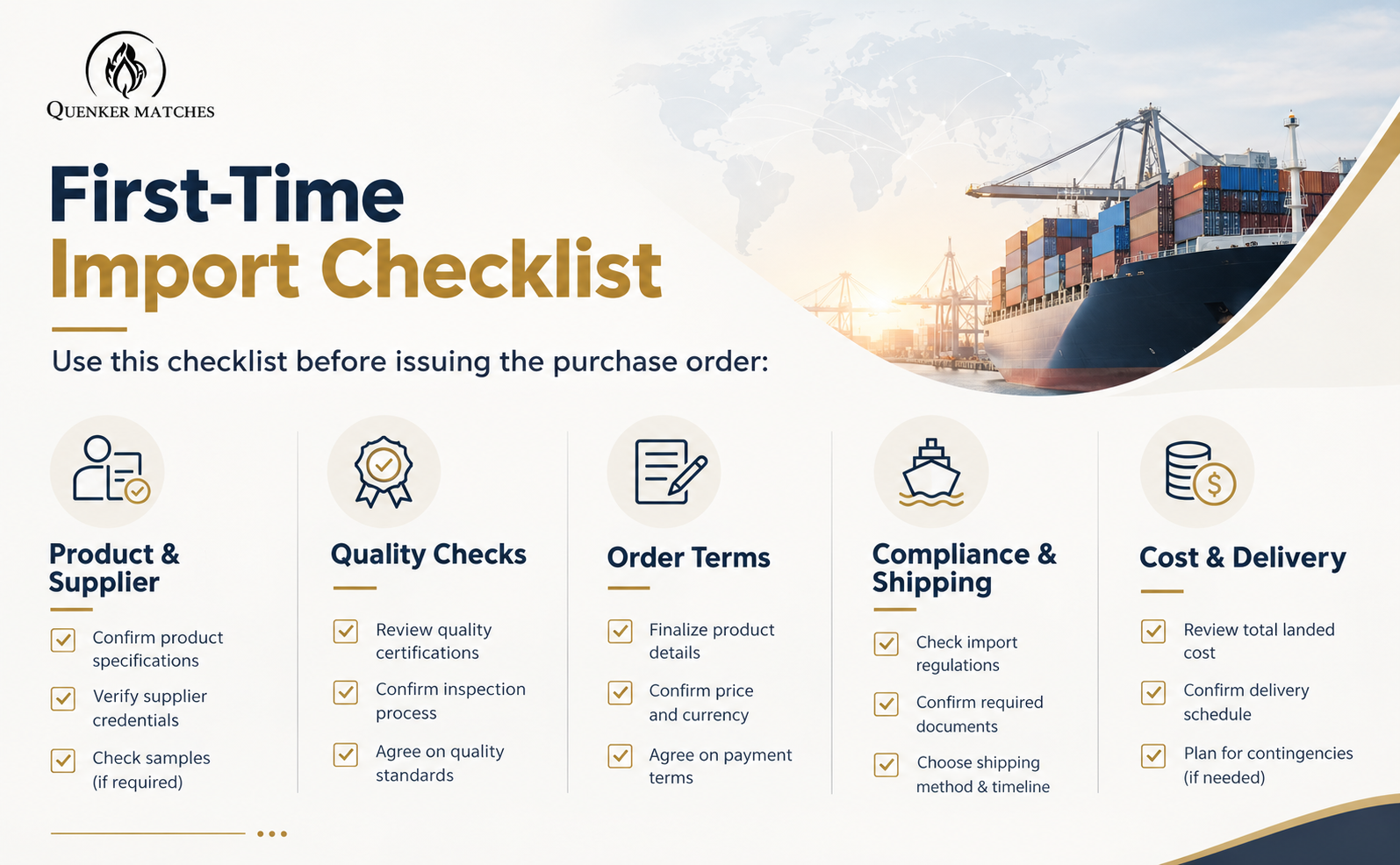
- Product & Supplier: Confirm specifications, packaging, and supplier credentials.
- Quality Checks: Approve samples and inspection standards.
- Order Terms: Verify MOQ, lead time, Incoterms, and payment terms.
- Compliance & Shipping: Check import regulations, safety requirements, and shipping documents.
- Cost & Delivery: Calculate landed costs, arrange insurance, and confirm delivery.
Plan Your First Safety Matches Import with Quenker Matches
Executing a successful import requires a dependable manufacturing partner, clearly defined product specifications, quality checks, and transparent commercial terms. Quenker Matches, based in Kovilpatti, provides safety match products for bulk buyers. Careful planning helps importers manage costs, reduce shipment risks, and establish a consistent supply chain.
4 Reasons to Choose Quenker Matches
- Established Manufacturing Experience: Involved in match manufacturing since 1980.
- Multiple Product Options: Offers wooden, cardboard, and kitchen safety matches.
- Bulk Packaging Solutions: Provides packaging options for different product and market requirements.
- Export-Oriented Supply: Supports buyers exploring international sourcing and bulk supply arrangements.
By defining your target market, order quantity, packaging needs, and delivery timeline, you can evaluate the most suitable import arrangement.
Final Words
Planning a bulk safety match import requires careful supplier evaluation, quality checks, accurate documentation, and realistic cost calculations. With manufacturing experience dating back to 1980, Quenker Matches offers safety match options for bulk buyers. A well-structured import plan helps businesses manage risks, maintain product consistency, and build a reliable supply chain for long-term growth.
Partner with Quenker Matches for tailored quotations and export solutions that match your business needs.
