
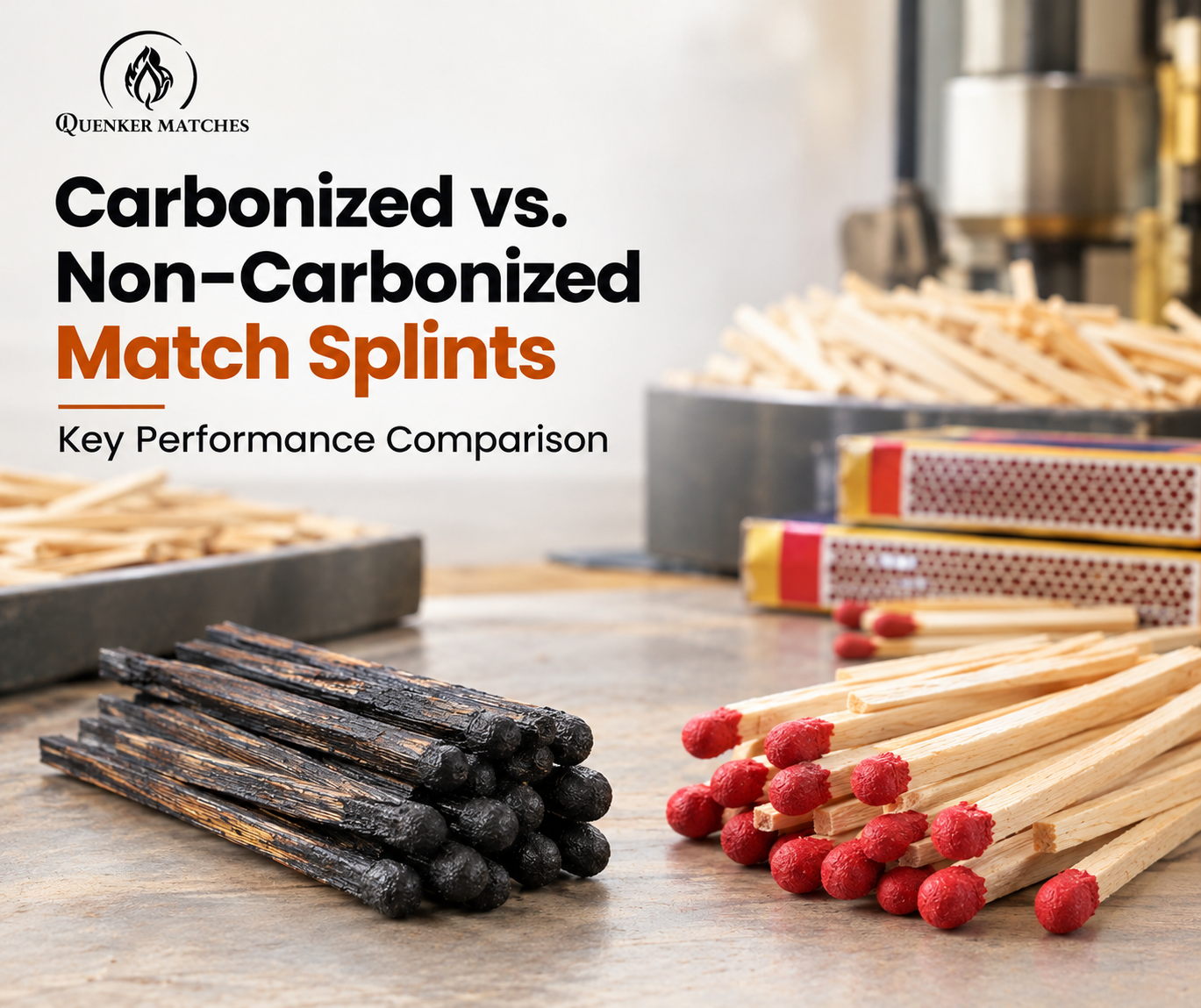
Choosing the right match splint directly affects ignition reliability, burning consistency, strength, and how well the finished match performs during storage, transport, and actual use. Many buyers still feel unsure about the difference between carbonized and non-carbonized wooden splints. This guide clears that confusion with Carbonized and Non-Carbonized Match Splints with practical comparison.
What Are Carbonized and Non-Carbonized Match Splints?
Match splints are the wooden stems that hold the match head and carry the flame after ignition. Their performance depends on wood species, moisture content, dimensions, porosity, and any treatment applied during manufacturing.
Non-carbonized match splints
Non-carbonized match splints keep the natural structure of the wood after proper drying and processing. Their performance depends mainly on the quality of the timber, moisture control, and wax impregnation.
Carbonized match splints
Carbonized match splints go through a controlled treatment process (mild thermal modification or chemical treatment). This process changes the wood’s surface chemistry and structure. As a result, carbonized splints usually offer better moisture resistance, improved durability, and more controlled burning behaviour.
The right match splints choice depends on your product’s end use and market conditions.
Performance Comparison
| Performance Factor | Carbonized Splints | Non-Carbonized Splints |
|---|---|---|
| Durability | Higher resistance to breakage | Reliable strength when well processed |
| Burning behaviour | Longer and more controlled burn | Smooth and consistent burn |
| Moisture resistance | Significantly better | Depends heavily on packaging & storage |
| Ignition & flame transfer | Reliable | Excellent when moisture is well controlled |
| Porosity & absorption | Modified for more uniform uptake | Natural absorption characteristics |
| Best suited for | Export, outdoor, emergency, humid markets | Household, retail, hospitality |
| Cost profile | Higher performance value | More cost-effective for standard use |
Carbonized matchsticks can offer several practical advantages when the finished product requires additional durability and environmental resistance.
Enhanced Durability
Splints need to survive several stages before reaching the consumer, including cutting, drying, treatment, match-head application, packing, transportation, and striking. A durable splint helps reduce breakage throughout these processes.
Carbonized splints are therefore worth considering when durability is a major procurement requirement.
Longer Burning Performance
Burn duration is another important consideration when designing a match. Quenker Matches associates its carbonized splints with longer burning performance, making them suitable for applications where a more sustained flame is desirable.
Consequently, manufacturers should evaluate the complete finished match rather than assuming that carbonization alone determines burn time.
Better Moisture Resistance
Moisture can affect wooden matchsticks during storage and transportation. Excess moisture may influence ignition, material integrity, chemical absorption, and burning consistency.
Carbonized splints can be advantageous in applications where moisture resistance is an important consideration. This makes them particularly relevant for export-oriented products and markets where matches may experience varying storage or transportation conditions.
How Non-Carbonized Match Splints Perform
Non-carbonized splints remain widely relevant for products where smooth ignition and dependable everyday performance are the main priorities.
Smooth Ignition
A match must transition efficiently from friction to ignition at the head and then transfer the flame to the wooden splint. A properly manufactured non-carbonized splint can support this transition when its moisture, porosity, dimensions, and chemical treatment are appropriately controlled.
For retail products and household matches, smooth ignition can be more important than additional environmental resistance.
Consistent Flame
Consistency is essential for finished matches. Variations in splint dimensions, moisture, porosity, or treatment can influence the way individual matches ignite and burn.
Non-carbonized splints can deliver uniform performance when manufacturers maintain consistent raw-material selection and production controls.
Practical Everyday Applications
Non-carbonized splints can be suitable for retail-oriented products, household applications, hospitality requirements, and other situations where standard ignition and burning characteristics meet the buyer’s requirements.
The decision should still be based on product specifications rather than assuming that non-carbonized splints are suitable for every application.
 How Match Stick Strength and Porosity Affect Performance
Strength and porosity are two important characteristics that procurement and quality-control teams should evaluate when sourcing safety match raw materials.
Match Stick Strength
A match splint should have sufficient structural integrity to withstand manufacturing, packing, transportation, and consumer use. Excessive bending or breakage can increase production losses and affect customer satisfaction.
Strength is influenced by:
- Wood species
- Grain orientation
- Splint dimensions
- Moisture content
- Drying conditions
- Manufacturing processes
- Material defects
For this reason, selecting premium wood alone is not enough. Consistent processing and quality control are equally important.
Match Splint Porosity
Wood contains a naturally porous structure. These pores influence how the splint interacts with substances used during match manufacturing, including waxes and other treatments. Porosity can therefore influence:
Wood structure → absorption → flame transfer → burning behaviour
If porosity varies significantly between splints, chemical or wax absorption may also vary. This can contribute to inconsistent ignition or burning characteristics in finished matches.
Carbonization and subsequent processing can change how the splint interacts with these materials. However, it is not technically accurate to assume that all carbonized splints have a specific porosity level.
When to Choose Carbonized Splints
Carbonized splints are worth considering when you need:
- Higher durability during packing, transport, and handling
- Better resistance to moisture
- Longer and more controlled burning performance
- Greater reliability in outdoor or emergency applications
These advantages make carbonized splints a strong option for export markets, outdoor matches, emergency kits, and products that face challenging storage or transportation conditions.
When to Choose Non-Carbonized Splints
Non-carbonized splints perform very well when:
- Smooth and reliable ignition is the top priority
- The product will be used mainly indoors under normal conditions
- You want good everyday performance at a more economical cost
They remain the preferred choice for most household, retail, and hospitality matches.
What Buyers Should Check Before Ordering
- Wood species (Poplar and Malabarica are commonly used)
- Splint dimensions (40 mm and 42 mm are standard options)
- Moisture content and control during production
- Breakage resistance under real handling conditions
- Consistent ignition and flame transfer
- Batch-to-batch consistency (very important for bulk orders)
At Quenker Matches, we supply both carbonized and non-carbonized wooden splints in 40 mm and 42 mm sizes. This allows buyers to select the exact specification that matches their market requirements.
Recommended Choice by Application
| Application | Recommended Splint Type | Reason |
|---|---|---|
| Household / Retail | Non-carbonized | Smooth ignition + cost-performance |
| Hospitality | Either | Depends on storage conditions |
| Export Markets | Carbonized | Moisture resistance + durability |
| Outdoor / Camping | Carbonized | Environmental exposure |
| Emergency Kits | Carbonized | Reliability under tough conditions |
| Private Label | Either | Based on buyer’s specific requirements |
Frequently Asked Questions
1. Is carbonized always better than non-carbonized?
No. Carbonized splints offer advantages in durability and moisture resistance, but non-carbonized splints often deliver smoother ignition for everyday household use.
2. Do carbonized splints burn longer?
In most cases, yes. They generally provide a more controlled and sustained burn, though the final burn time also depends on wax impregnation and match-head formulation.
3. Which splint is better for export?
Carbonized splints are usually preferred for export because of better moisture resistance and higher durability during long transportation.
4. Can I get samples of both types?
Yes. Many buyers request sample packs of both carbonized and non-carbonized splints to test performance with their own match-head composition.
Final Recommendation
Choose carbonized match splints when durability, moisture resistance, and reliable performance under demanding conditions are important. Choose non-carbonized match splints when smooth ignition and cost-effective everyday performance are the main requirements.
The best decision always comes from testing samples against your actual production process and target market conditions.
Ready to choose the right splint for your product?
Request a free sample pack from Quenker Matches, or contact us for bulk pricing and customized options.
