
Introduction
When choosing a safety matches wholesale supplier, the difference between a reliable partner and a low-quality manufacturer isn’t always visible on a product sheet. It shows up in failed ignitions, moisture-damaged stock, customs rejections, and frustrated end customers.
This guide breaks down five concrete, verifiable differences between Quenker Matches and typical competitors — backed by specifics on materials, certifications, and export experience — so wholesale buyers, distributors, and importers can make confident, data-driven sourcing decisions.
What should you check in a safety matches wholesale supplier?
A reliable safety matches wholesale supplier should offer consistent raw materials, strong ignition performance, moisture-resistant packaging, export certifications like ISI and MSDS, and a proven track record in global markets.
Difference 1: Raw Material Quality in a Safety Matches Wholesale Supplier
What Quenker Uses
Quenker Matches sources two primary wood types for its splints: Malai Vembu (Indian Neem) and imported Poplar. Both are chosen for their uniform grain, low moisture absorption, and clean burn characteristics. Splints are treated with ammonium phosphate — a fire retardant — to slow burn rate and improve safety.
Each batch goes through:
- Log debarking and chemical treatment against fungal and insect damage
- Precision-cut splints polished to remove rough edges and ensure uniform sizing
- Wax dipping to create a moisture barrier before chemical head application
- Controlled drying chambers where temperature and humidity are monitored
The Problem With Inconsistent Suppliers
Many Indian match manufacturers source wood opportunistically, leading to variation in stick diameter, density, and moisture content across batches. This directly causes breakage during striking, uneven chemical coating, and ignition failure rates that are difficult to predict at scale.
For matchbox wholesale buyers ordering container loads, a 3–5% defect rate in a 20-foot container is not a minor inconvenience — it means thousands of unusable units and potential customer returns.
Difference 2: Single-Strike Ignition vs. Repeated Failure
The Chemistry Behind Reliable Ignition
A safety match ignites through a controlled reaction between the match head and the striking surface. Quenker’s match heads use a precisely balanced composition of potassium chlorate (oxidizing agent), sulfur and antimony sulfide (combustion fuel), powdered glass for friction, and stabilizing binders.
The striking surface on every Quenker matchbox contains red phosphorus — a stable, safer alternative to white phosphorus — combined with powdered glass and binders applied at a controlled thickness.
Why Other Matches Fail
Common ignition failures in standard safety matches stem from two causes: inconsistent phosphorus coating on the striking surface (applied too thin or uneven), and variable match head chemical ratios that produce a flame too weak to sustain.
Note: Request ignition test data or a sample batch test before placing a large wholesale order.
Difference 3: Moisture Resistance in Safety Matches Wholesale Supply
How Quenker Ensures for Humidity
India’s tropical climate — and the export routes Quenker serves (Sub-Saharan Africa, the Middle East, Southeast Asia) — demand products that perform in high-humidity environments. Quenker addresses this at multiple production stages:
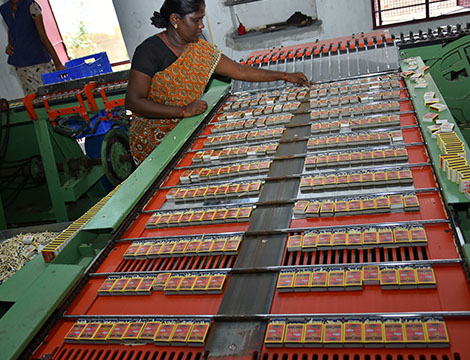
- Wax-dipped splints create a moisture barrier around the wood before chemical heads are applied
- Veneer safety matches are fully moisture-proof
- Cardboard safety matches use fine-grade duplex board that resists humidity-induced warping
- Packaging uses moisture-sealed wrapping for export cartons
The Cost of Moisture-Damaged Stock
Standard safety matches that absorb moisture during a 4–6 week ocean transit can arrive with softened splints, degraded striking surfaces, and match heads that crumble rather than ignite. For distributors, this means either writing off stock or passing defective product to retail — neither is acceptable.
Quenker’s veneer matches — made with rubberwood outer casing and duplex board inner box — are specifically marketed on their 100% moisture-proof certification, a claim that can be independently verified.
Difference 4: Export-Grade, Customizable Packaging
Quenker’s Packaging Options
Quenker offers a structured range of packaging configurations designed for both retail and bulk logistics:
- 10-matchstick packs in blue paper packaging (retail/hotel)
- 100-matchstick packs in labeled blue paper packaging
- 1,000-matchstick packs in 3-ply color-printed cartons or brown kraft cartons
- Container-load bulk packaging in moisture-resistant wrapping
Matchbox dimensions are customizable across seven standard sizes (from 45×31×14mm to 51×35×14mm) with carton quantities ranging from 2,400 to 3,150 units per carton. Custom branding — including private-label matches printing for hotels, restaurant chains, and retail brands — is available with minimum order quantities starting at one 20-foot container.
Why Packaging Matters for Wholesale Buyers
Packaging failure during transit is one of the leading causes of damaged goods claims in the match trade. Boxes that warp, tear, or allow moisture ingress don’t just hurt the product — they undermine the distributor’s brand credibility with their retail customers.
Basic duplex board packaging with no moisture sealing is common among lower-tier manufacturers. Quenker’s export cartons are engineered to withstand rough container handling and climate variation across shipping routes.
Takeaway: Confirm carton weight limits, stacking specifications, and moisture-sealing details before placing orders for humid-climate destinations.
Difference 5: Certifications Every Safety Matches Wholesale Supplier Must Have
Quenker’s Certification and Process Standards
Quenker Matches holds ISI certification — India’s Bureau of Indian Standards mark — which requires compliance with IS 1504 (safety matches standard). This covers match head chemical composition limits, ignition reliability thresholds, and packaging labeling requirements.
Every batch undergoes ignition testing before shipment. Exporters are provided Material Safety Data Sheets (MSDS) and compliance documentation required by international trade authorities, including shipping declarations for hazardous goods classification.
The Risk of Uncertified Matches
Low-quality matches without consistent certification carry real risks beyond ignition failures:
- Uncontrolled flare-ups during the first second of combustion — a common issue with over-dosed match heads
- Splint fracture during striking, which can send ignited fragments beyond the intended burn zone
- Customs detention or rejection in markets that require MSDS documentation
- Liability exposure for distributors if product-related incidents occur in-market
Buyer Takeaway: Always request ISI certification, MSDS documents, and a batch test report before importing.
Safety Matches Wholesale Supplier Comparison: Quenker vs Typical Suppliers
The table below summarizes the key differences across product, process, and commercial factors:
| Feature | Quenker Matches | Typical Suppliers |
| Raw Materials | Malai Vembu (Indian Neem) & Poplar splints, ammonium phosphate treated | Generic softwood, variable treatment standards |
| Ignition Performance | Single-strike ignition; precise potassium chlorate & sulfur composition | Frequent multi-strike failures; inconsistent chemical coating |
| Moisture Resistance | Wax-dipped splints + moisture-resistant packaging; | Standard matches absorb moisture; prone to structural failure |
| Packaging | Export-grade, customizable (3-ply cartons, branded labels, moisture-sealed wrapping) | Basic duplex board; not suited for long-haul export |
| Safety & Certification | ISI-certified; batch-level ignition testing before every shipment | Certification varies widely; limited quality checkpoints |
| Export Experience | Exporting since early 2000s to 15+ countries (UAE, Saudi Arabia, Kenya, South Africa, Chile) | Limited export track record or market-specific customization |
How These Differences Play Out for Buyers
For Wholesale Distributors
Distributors working with inconsistent Indian match brands face a common pattern: quality holds for 2–3 container orders, then a bad batch arrives — wrong ignition rate, damaged packaging, or moisture-affected stock. Switching suppliers mid-season disrupts supply chains and damages retailer relationships.
Quenker’s 4-decade manufacturing history (founded 1980) and documented export relationships with buyers in Saudi Arabia, UAE, Kenya, South Africa, Ghana, Nigeria, Vietnam, Sri Lanka, and Chile provide a track record that newer or less established manufacturers cannot match.
For Hotel, Restaurant, and Hospitality Importers
Hotel-branded matches are a high-visibility product. A match that fails to light at a fine-dining table is a brand moment that guests remember. Quenker’s customizable private-label packaging — with match head color options and box print customization — is designed specifically for the hospitality segment, where presentation and reliability must both be delivered.
For Export Market Buyers (Africa, Middle East, Southeast Asia)
Quenker Matches is a leading safety matches wholesale supplier in India, exporting to Africa, the Middle East, and Southeast Asia. Buyers sourcing for tropical markets need moisture-proof products, compliant documentation, and a supplier with established logistics experience. Quenker exports in specialized containers to prevent moisture and heat exposure during transit, and provides all required export documentation including MSDS and shipping declarations.
Why Kovilpatti, Tamil Nadu Is India’s Safety Match Hub
Quenker Matches is based in Kovilpatti, Tamil Nadu — historically India’s largest safety match manufacturing cluster. The region’s concentration of raw material suppliers, skilled labour, and industry expertise creates a supply chain efficiency that manufacturers based elsewhere in India cannot replicate.
 This geographic advantage directly benefits wholesale buyers through faster production cycles, lower logistics costs to major Indian export ports, and access to specialized inputs like Malai Vembu (Indian Neem) wood that are regionally sourced.
Conclusion
Choosing the right safety matches wholesale supplier is not just a procurement decision — it’s a long-term business investment. Quenker Matches stands out as a reliable safety matches wholesale supplier with proven export experience, consistent quality, and certified products.
The wrong safety matches wholesale supplier can cost more in returns, damage, and lost customers than any savings on price.
👉 Contact us today to request samples, pricing, or bulk supply details.
Frequently Asked Questions
1. What wood does Quenker use in its matchsticks?
Quenker uses Malai Vembu (Indian Neem) and imported Poplar for splints. Both are treated with ammonium phosphate to slow burn rate and resist moisture. Some product lines use rubberwood for outer casing in veneer matches.
2. Are Quenker matches suitable for humid-climate markets like West Africa or Southeast Asia?
Yes. Quenker’s veneer safety matches are certified 100% moisture-proof. All export product lines use wax-dipped splints and moisture-sealed packaging. The company has established export relationships in Kenya, Ghana, Nigeria, Vietnam, and Sri Lanka.
3. What is the minimum order quantity for Quenker’s matchbox wholesale?
The minimum order typically starts at one 20-foot container, though this varies by product type and destination. Contact Quenker directly for market-specific MOQ details.
4. Does Quenker offer private-label or custom branded matchboxes?
Yes. Quenker offers full customization including box size, match head color, printed labels, and branding. This service is used by hotels, restaurant chains, and retail brands across its export markets.
5. What certifications does Quenker hold?
Quenker holds ISI certification under India’s Bureau of Indian Standards. The company provides MSDS documentation, shipping declarations, and compliance reports for international trade requirements.
6. How to choose a safety matches wholesale supplier?
A good safety matches wholesale supplier should provide consistent quality, moisture resistance, export certifications, and a strong track record in bulk supply.
