Category: Safety Matches

Blog Safety Matches

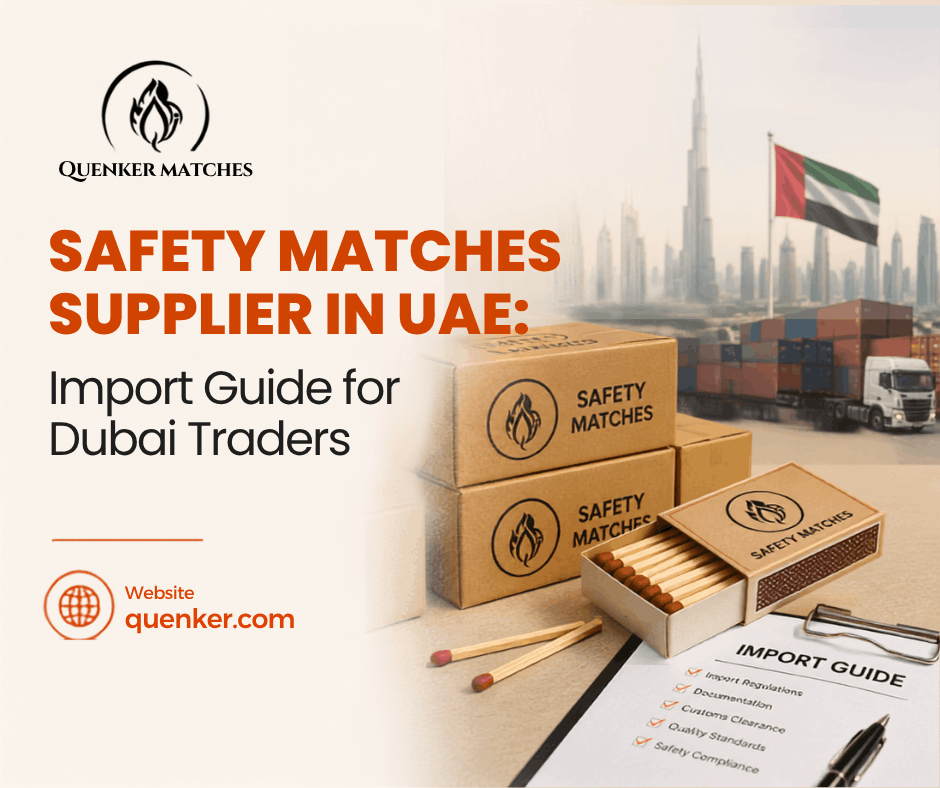
Safety Matches Supplier in UAE: Import Guide for Dubai Traders

Introduction
Dubai has established itself as one of the most influential trading hubs in the Middle East, connecting manufacturers and distributors across the GCC, Africa, and Asia. As the FMCG sector continues to expand across the UAE, the demand for everyday consumer products such as safety matches remains essential. For businesses looking for a reliable safety matches supplier UAE Dubai, understanding import regulations, supplier selection criteria, logistics, and customs procedures is essential for successful sourcing.

This guide provides everything Dubai traders need to know about sourcing quality safety matches, navigating customs requirements, and partnering with trusted manufacturers for long-term supply success.
Why Dubai is a Primary Market for Safety Matches Imports
Growing Demand Across various Sectors
Safety matches continue to be a staple household and commercial product across the UAE. They are widely used in homes, restaurants, catering businesses, hotels, campsites, and convenience stores. The country’s growing population and growing tourism industry contribute to consistent demand throughout the year.
Dubai as a Re-Export Hub for GCC Markets
Dubai serves as a strategic gateway to neighboring GCC countries including Saudi Arabia, Oman, Bahrain, Kuwait, and Qatar. Many importers purchase products in bulk and distribute them across the region, making Dubai an important center for safety matches wholesale UAE operations.
Opportunities for UAE Match Buyers
The UAE’s strong logistics infrastructure, business-friendly regulations, and access to international shipping routes create excellent opportunities for wholesalers. Businesses sourcing from a trusted matchbox supplier UAE can benefit from steady inventory availability and competitive pricing for regional distribution.
Understanding the UAE Safety Matches Import Market
Major Buyers of Safety Matches in Dubai
The UAE market includes a diverse range of buyers, such as:

FMCG distributors
Hypermarkets and supermarkets
Grocery store chains
Hospitality suppliers
Wholesale traders
Export and re-export companies

These businesses often require consistent product quality, reliable supply schedules, and customized packaging options.
Popular Safety Match Products Imported into UAE
Importers typically source various matchbox categories to cater to different consumer preferences:

Cardboard safety matches
Wax safety matches
Household safety matches
Kitchen matches

Having access to multiple product options allows distributors to serve different retail segments efficiently.
Current Market Trends
The demand for safety matches in the UAE continues to grow due to expanding retail networks, a thriving hospitality sector, increasing GCC re-export activities, rising demand for affordable household products, and the growing popularity of private-label FMCG brands.
UAE Import Regulations for Safety Matches
i) HS Code Classification for Safety Matches
Safety matches are generally classified under HS Code 3605. Proper classification is essential during customs declaration to ensure smooth clearance procedures and avoid unnecessary delays. Traders should always verify the latest tariff classifications, import regulations, and customs requirements through the UAE Federal Customs Authority before importing safety matches into Dubai and other UAE markets.

Importers should always verify the latest tariff classification requirements with UAE customs authorities or licensed customs brokers before shipment.
ii) Customs Duty UAE: What Importers Should Know
One of the most frequently searched topics among traders is safety matches customs duty UAE. Imported safety matches are generally subject to UAE customs duties, typically calculated on the CIF (Cost, Insurance, and Freight) value of the shipment.

In addition to customs duty, applicable VAT charges may also apply depending on prevailing regulations. Importers should maintain accurate documentation to facilitate efficient customs processing.
iii) Required Import Documents for Customs Clearance
Dubai traders should ensure the following documents accompany each shipment:

Commercial Invoice
Packing List
Certificate of Origin
Product Specifications
Customs Declaration Documents

Proper documentation helps reduce the risk of customs delays and compliance issues.
iv) UAE Product Compliance and Packaging Requirements
Importers should verify that products meet UAE packaging and labeling standards. Product packaging should be durable, clearly marked, and suitable for retail distribution. Working with an experienced exporter helps ensure compliance with destination market requirements.
Choosing the Right Safety Matches Supplier UAE Dubai
Selecting the right supplier is one of the most important decisions for importers. A dependable safety matches supplier UAE Dubai can significantly improve supply chain efficiency and product reliability.
1. Manufacturing Certifications and Quality Standards
Reliable manufacturers should maintain strict quality control systems and follow internationally recognized production standards. Consistent quality reduces customer complaints and enhances brand reputation.
2. Export Experience and UAE Market Knowledge
Export experience matters when dealing with international trade requirements. Suppliers familiar with UAE regulations are better equipped to provide the documentation and support needed for smooth imports.
3. Production Capacity and Consistent Supply
Distributors often require large volumes during peak demand periods. Suppliers should have adequate manufacturing capacity to meet recurring orders without compromising quality.
4. Product Customization and Private Label Options
Various UAE importers look for customized packaging and private-label opportunities to differentiate themselves in the market. Manufacturers offering flexible branding solutions provide additional value to distributors.
5. Documentation Support for UAE Imports
A professional exporter should assist with export documentation, certificates, shipping paperwork, and customs-related requirements, helping traders avoid costly errors.
Import Safety Matches Dubai: Shipping and Logistics Guide
Preferred Shipping Routes from India to Dubai
India remains one of the most preferred sourcing destinations due to its manufacturing expertise and geographic proximity. For businesses planning to import safety matches Dubai, sea freight remains the most economical shipping option.

Typical shipping routes involve dispatch from South Indian ports to Dubai’s major cargo terminals.
Transit Time to Jebel Ali Port
Most shipments from India reach Jebel Ali Port within approximately 10 to 20 days, depending on vessel schedules, weather conditions, and shipping routes. Efficient planning helps importers maintain inventory continuity and avoid stock shortages.
Factors Affecting Shipping Lead Times
Several factors can influence delivery schedules:

Seasonal shipping demand
Port congestion
Customs inspections
Documentation readiness
Production timelines

Partnering with experienced exporters minimizes many of these challenges.
Tips for Avoiding Logistics Delays
To streamline operations:

Place orders well in advance
Confirm production schedules
Verify documentation accuracy
Maintain communication with freight partners
Monitor shipment progress regularly

These practices support smoother import operations and better inventory management.
Common Challenges for Dubai Safety Matches Importers
i) Identifying Genuine Manufacturers
Counterfeit products can damage business reputation and lead to compliance issues. Traders should conduct supplier verification and request factory credentials before placing orders.
ii) Managing Minimum Order Quantity Requirements
Small and medium-sized traders often face challenges when suppliers impose high minimum order quantities. Choosing a flexible safety matches supplier UAE Dubai can help businesses manage inventory and cash flow more effectively.
iii) Preventing Customs Documentation Errors
Incomplete paperwork can delay customs clearance and increase costs. Importers should carefully review all documents before shipment dispatch.
iv) Ensuring Consistent Product Quality Across Shipments
Consistency is essential for maintaining customer satisfaction. Importers should work with manufacturers that implement strict quality assurance procedures throughout production.
Pre-Order Supplier Checklist for Dubai Businesses
Before selecting a safety matches supplier UAE Dubai, traders should verify the following:
Quality Assurance Verification
✔ Product testing procedures

✔ Quality control systems

✔ Manufacturing standards
Export Documentation Readiness
✔ Commercial documentation support

✔ Certificate availability

✔ Customs compliance assistance
Packaging and Labeling Compliance
✔ UAE-compliant packaging

✔ Barcode support

✔ Private-label capabilities
Pricing, MOQ, and Delivery Assessment
✔ Competitive pricing

✔ Flexible MOQ options

✔ Reliable lead times

✔ Shipping support

Following this checklist enables Dubai traders to evaluate suppliers more effectively, minimize potential sourcing risks, ensure compliance requirements are met, and make confident purchasing decisions that support long-term business success.
Benefits of Sourcing Safety Matches from India for UAE Markets
Competitive Wholesale Pricing
Indian manufacturers benefit from established production infrastructure and efficient manufacturing processes, helping traders secure competitive rates. This is particularly beneficial for businesses involved in safety matches wholesale UAE distribution.
Reliable Manufacturing Infrastructure
India has a long-standing reputation for safety match manufacturing, supported by skilled labor, modern production facilities, and export-oriented operations.
Faster Transit Times to Dubai
Compared to many distant sourcing regions, India offers relatively shorter shipping durations, making it easier to import safety matches Dubai while maintaining healthy inventory levels.
Flexible Packaging and Custom Branding Support
Indian exporters often provide customized packaging, private labeling, and product adaptation services tailored to the requirements of UAE distributors and retailers.
Why Quenker Matches Is a Trusted Safety Matches Supplier UAE Dubai
Quenker Matches, is a trusted safety matches supplier UAE Dubai importers rely on for consistent quality, competitive pricing, and dependable deliveries. With extensive export experience, customized packaging solutions, and a diverse range of products, we support businesses involved in import safety matches Dubai and safety matches wholesale UAE markets.

Our focus on delivering consistent product quality, meeting international export standards, and providing responsive customer support has helped us build long-term partnerships with importers, distributors, and wholesalers throughout the UAE and wider GCC markets.
Trusted Export Solutions for Safety Matches Buyers in UAE
At Quenker Matches, we understand that successful importing depends on partnering with a manufacturer that combines quality, reliability, and export expertise. Backed by modern manufacturing infrastructure, stringent quality control processes, and aligning to international production standards, we ensure every shipment meets the expectations of global buyers. 

As a trusted safety matches supplier UAE Dubai importers rely on, we offer export-quality products, customized packaging solutions, competitive pricing, and efficient logistics support.  Our commitment to consistency, compliance, and customer satisfaction enables distributors, wholesalers, and retail chains across the UAE and GCC region to build a dependable and profitable supply chain.
Partner with Quenker Matches for premium safety matches, flexible bulk orders, and dependable delivery across Dubai and GCC markets. Request your quote today.

Posted by quenker-editor
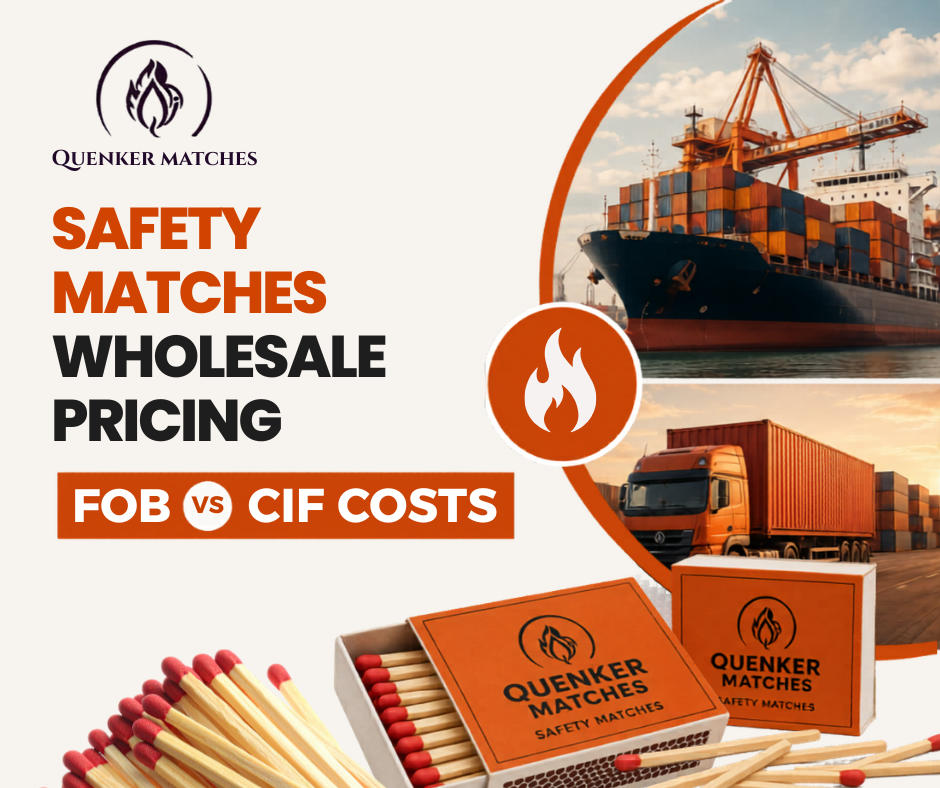
Safety Matches Wholesale Pricing 2026 showing FOB vs CIF cost comparison for international safety matches import and export pricing
Blog Safety Matches

Safety Matches Wholesale Pricing 2026: FOB vs CIF Costs

Introduction
The global household essentials market continues to witness stable demand for safety matches, especially across Africa, the Middle East, and developing Asian economies. In 2026, importers, distributors, and FMCG procurement teams are increasingly searching for transparent insights into the safety matches wholesale price to make profitable sourcing decisions amid fluctuating freight rates and currency volatility.

For bulk buyers, understanding the difference between FOB and CIF pricing is no longer optional. Unexpected shipping charges, customs costs, and logistics risks can quickly reduce margins if procurement teams fail to evaluate the complete landed cost. This is why many international buyers now compare not only the product price but also the overall bulk safety matches import cost before finalizing suppliers.

As a trusted matchbox wholesale supplier from Kovilpatti, Tamil Nadu, Quenker Matches helps global importers navigate export pricing with clarity, quality assurance, and flexible shipping options.
Understanding Safety Matches Wholesale Price in 2026
The safety matches wholesale price in 2026 depends on several interconnected factors, including raw material costs, carton quantity, packaging specifications, freight charges, and destination country regulations.

Unlike consumer retail pricing, export pricing for safety matches is largely volume-driven. Import buyers ordering full container loads typically receive better rates compared to smaller mixed shipments. In addition, customized packaging, private-label branding, and moisture-resistant export cartons also influence final pricing.

Another important factor is the type of match being exported. Wooden safety matches, wax matches, kitchen matches, and BBQ matches each have different production and packaging costs.
Average Safety Matches Per Carton Price
The safety matches per carton price in 2026 varies based on the type of match product, packaging specifications, order volume, and export requirements. Cardboard, wooden, wax, kitchen, and BBQ matches each have different production and packaging considerations that influence pricing. 

Additionally, factors such as shipping destination, container capacity, customization needs, and freight market conditions can significantly impact the final export quotation.
Types of Safety Matches for Bulk Export
International buyers today require multiple matchbox variants depending on their regional consumer demand and retail positioning.
i) Wooden Safety Matches
Wooden safety matches are widely preferred for durability, strong ignition performance, and premium household use. These products are popular in African and Middle Eastern markets due to their long-lasting burn quality.
ii) Wax Safety Matches
Wax matches are lightweight, economical, and moisture-resistant. They are highly suitable for humid regions and price-sensitive retail markets.
iii) Cardboard Safety Matches
Cardboard safety matches remain one of the most economical products for mass-market distribution and supermarket retail chains.
iv) Kitchen and BBQ Matches
Long-stick kitchen BBQ matches are gaining popularity among hotels, restaurants, and premium retail outlets. Their higher stick length and extended burn time justify a higher export value.
FOB vs CIF: Understanding for Import Buyers
One of the biggest areas of confusion in international procurement is understanding the difference between FOB and CIF pricing. An accurate understanding of the safety matches FOB CIF price structure can help buyers avoid hidden logistics expenses and improve procurement planning.
What is FOB?
FOB (Free On Board) is a common international shipping term where the exporter manages manufacturing, packaging, export clearance, and loading the shipment onto the vessel. 

After dispatch from the origin port, the buyer handles freight, insurance, and destination delivery. Many experienced importers prefer safety matches FOB CIF price comparison methods to gain better freight control and optimize procurement costs.
What is CIF?
CIF (Cost, Insurance, and Freight) means the exporter handles manufacturing, ocean freight booking, marine insurance, and shipment transportation to the destination port. The buyer manages import duties and local delivery after arrival. 

For companies evaluating bulk safety matches import cost, CIF pricing offers clearer visibility into total shipping expenses and simplifies international procurement planning.
Incoterms FOB CIF Comparison
An effective Incoterms FOB CIF comparison helps buyers evaluate risk exposure and operational responsibilities.

Feature
FOB
CIF

Freight Included
No
Yes

Insurance Included
No
Yes

Buyer Risk
Higher
Lower

Freight Control
Buyer
Seller

Best For
Experienced importers
New buyers

Understanding this Incoterms FOB CIF comparison is essential for long-term import profitability.
The final safety matches FOB CIF price may differ depending on:

Destination port
Fuel surcharges
Container availability
Freight seasonality
Insurance coverage

This is why importers should always request updated quotations before confirming orders.
Factors Affecting Bulk Safety Matches Import Cost
Understanding the complete bulk safety matches import cost helps buyers compare suppliers more accurately.
1. Raw Material and Costs
Wood quality, splint treatment, phosphorus composition, and packaging materials directly influence production pricing.
2. Order Volume
Large-volume importers benefit from economies of scale. Full container shipments reduce per-carton logistics expenses significantly.
3. Packaging Customization
Private labeling, multilingual printing, barcode stickers, and export-grade cartons can slightly increase unit pricing but improve retail appeal.
4. Freight Market Volatility
Ocean freight continues to fluctuate due to fuel prices, port congestion, and shipping route demand. These changes heavily impact the final bulk safety matches import cost.
5. Currency Exchange Fluctuations
Currency exchange rate volatility affects procurement budgets, especially for importers operating in local African or Middle Eastern currencies.
Container Size vs. Import Cost
The type of shipping container selected can significantly influence the overall bulk safety matches import cost. Different container sizes offer varying capacities, affecting freight efficiency and per-carton transportation expenses.
20-Foot Container (FCL)
A 20-foot container is suitable for moderate-volume orders and offers a cost-effective option for importers starting bulk procurement. It provides lower overall investment while maintaining efficient shipping and inventory management.
40-Foot Container (FCL)
A 40-foot container accommodates larger order quantities, helping reduce shipping costs per carton. High-volume importers often choose this option to maximize freight efficiency and achieve better economies of scale.
Less Than Container Load (LCL)
LCL shipping allows buyers to share container space with other shipments, making it suitable for smaller orders. However, higher handling charges and consolidation fees can increase the overall import cost per carton.
Why Global Buyers Choose Quenker Matches
At Quenker Matches, we are proud to support global buyers with reliable manufacturing, transparent communication, and seamless export coordination, making us a trusted name in safety matches export India. Our focus on consistent quality and efficient supply management helps importers source safety matches with confidence and long-term business reliability.
Extensive Range Safety Matches
We manufacture and export a wide variety of safety matches tailored for different international market requirements, including:
Export-Oriented Standards
Our production processes are designed to meet international export expectations while maintaining consistent quality across every shipment. We also support buyers with:

Private label and customized packaging solutions
Complete bulk export documentation assistance
Flexible carton and packaging configurations
Well-planned shipment scheduling and dispatch coordination

Transparent Pricing and Support
At Quenker Matches, we help importers understand both FOB and CIF pricing structures clearly, enabling better procurement planning and cost evaluation. For buyers comparing the safety matches wholesale price, our transparent quotation process simplifies decision-making and builds long-term sourcing trust.
Matchbox Quote Comparison Tips
When comparing quotations from matchbox suppliers, evaluate factors beyond price, including product quality, packaging specifications, MOQ, Incoterms (FOB/CIF), shipping terms, and export support. 
Questions Buyers Should Ask

Is the quote FOB or CIF?
What insurance coverage is included?
Are export documents included?
What is the minimum order quantity?
Is private labeling available?
Are moisture-resistant cartons used?

A reliable matchbox wholesale supplier will provide clear answers and detailed export documentation.
Final Verdict
The global safety matches industry in 2026 continues to offer strong opportunities for importers, wholesalers, and FMCG distributors. However, understanding the true safety matches wholesale price requires more than simply comparing factory quotations.

Whether you choose FOB or CIF, working with an experienced exporter can significantly reduce risk and improve supply chain efficiency. As a trusted partner in safety matches export India, Quenker Matches provides transparent pricing, export expertise, and customized bulk supply solutions for global markets.
Request 2026 matchboxes wholesale pricing from Quenker Matches for bulk sourcing.

Posted by quenker-editor
Blog Safety Matches

Matchbox Wholesale Distributor in Nigeria: Import Guide for Traders and Bulk Buyers

Introduction
“In Nigeria’s fast-moving FMCG market, products with consistent daily demand often generate the strongest long-term trade opportunities.”
Nigeria’s FMCG sector is witnessing rapid growth due to increasing population, expanding retail networks, and rising consumption of essential household products. This growing consumption has significantly increased the need for a reliable matchbox wholesale distributor Nigeria, particularly among importers seeking certified, affordable, and high-quality products from established manufacturing countries like India.

For wholesale traders, distributors, and procurement buyers, understanding the right import strategy is essential to avoid low-quality shipments, customs complications, and supply chain delays. This guide covers everything from supplier selection and SON compliance to shipping logistics, customs clearance, and bulk pricing considerations for importing matchboxes into Nigeria.
Nigerian Market Overview and Import Demand
The Nigerian FMCG distribution ecosystem relies heavily on imported essential goods due to consistent domestic supply gaps. Safety matches are one of the most frequently imported household ignition products, making them a stable high-turnover commodity.

A reliable matchbox wholesale distributor Nigeria plays a key role in supplying large volumes to Lagos, Kano, and Onitsha markets where wholesale trading is concentrated. However, importers often face challenges such as inconsistent quality, counterfeit packaging, and unreliable delivery timelines.

As a result, many importers choose to work directly with trusted manufacturers, known for delivering export-quality safety matches and flexible bulk supply solutions tailored for African markets.
Step-by-Step FMCG Import Guide
Importing matches into Nigeria involves a structured process that ensures compliance, quality assurance, and smooth customs clearance.
1. Identify a Certified Supplier
Begin by partnering with a trusted export-focused manufacturer known for consistent product quality and international supply capabilities. India remains a preferred sourcing destination for many buyers because of its cost-effective production and established manufacturing centers such as Kovilpatti. Always confirm that the supplier can efficiently handle import matchbox Nigeria bulk orders while maintaining strict quality standards.
2. Request Product Samples
Before placing bulk orders, always request samples to evaluate ignition quality, packaging durability, and moisture resistance. Poor-quality matches often fail in compliance, resulting in shipment rejection.
3. Verify Certifications and Compliance
To avoid regulatory issues, ensure the supplier provides export documentation, including:

Commercial Invoice
Packing List
Certificate of Origin
Quality inspection reports

These factors become crucial when evaluating suppliers from a well established safety matches importers in Nigeria.
4. Confirm Pricing Terms (FOB/CIF)
Understanding pricing structures is critical. Most suppliers offer:

FOB (Free on Board): Buyer handles shipping from origin port
CIF (Cost, Insurance, Freight): Supplier manages shipping to Nigerian port

Many buyers compare matchbox FOB price India to optimize landed cost per carton.
5. Arrange Shipping and Logistics
Sea freight is the most common method, with transit times from India to Nigeria typically ranging between 25–40 days depending on port congestion. Major entry points include Apapa Port and Tin Can Island Port.
Understanding SON Standards for Certified Matches Nigeria Imports
The Standards Organisation of Nigeria (SON) plays a crucial role in regulating imported FMCG products, including safety matches. Importers of matchbox FOB price India must ensure their shipments meet SON requirements to avoid delays or rejections.

Key compliance requirements include:

Product must meet ignition safety standards
Packaging must be moisture-resistant and sealed
Proper labeling in accordance with Nigerian import regulations

The HS Code for safety matches is:
HS Code 3605 00 00 — Matches
Applicable import duties vary depending on trade classification, but generally fall within Nigeria’s FMCG tariff structure and may include customs duty, VAT, and port charges.

For importers, working with a certified matches Nigeria supplier reduces compliance risk significantly.
Evaluation Guide for Matchbox Supplier
Before finalizing a partnership with a matchbox supplier Lagos, importers should carefully assess the supplier’s credibility, export capabilities, and product quality standards to ensure reliable long-term business operations.

Checklist includes:

Verified export experience to Africa
Ability to handle bulk production
Consistent packaging quality control
Positive trade references
Export documentation readiness

A trusted matchbox supplier Lagos chain ensures stable supply to distributors across Nigeria’s largest commercial places.
Logistic Challenges
Shipping FMCG goods like safety match box for Nigeria requires careful planning due to port congestion and customs inspection procedures.

Typical logistics flow:

Process Stage
Estimated Timeline

Production & Packaging
7–15 Days

Container Loading & Export Clearance
3–5 Days

Sea Freight Transit
25–40 Days

Nigeria Customs Clearance
5–10 Days

Importers working with FMCG import guide Nigeria match strategies must anticipate delays at Apapa Port due to inspection queues and documentation verification.

Proper packaging and compliance significantly reduce clearance delays and risk of cargo detention.
Pricing Insights: Wholesale Matches Nigeria Price Structure
Pricing depends on:

Order volume (bulk pricing advantage)
Packaging type (private label vs standard)
Shipping terms (FOB vs CIF)
Raw material costs (wood, wax, chemicals)

Importers evaluating wholesale matches Nigeria price should always calculate landed cost per carton, including duties and port handling charges, before finalizing supplier agreements.
Reasons for Choosing Quenker Matches for Nigerian Markets
Quenker Matches has established itself as a trusted export-oriented safety matches manufacturer by consistently delivering quality, reliability, and customized solutions for international buyers, especially, certified matches Nigeria. With strong manufacturing expertise from Kovilpatti, we are one of India’s leading safety match box for Nigeria, we understand the specific requirements of Nigerian FMCG distributors, wholesalers, and retail supply chains.

As a trusted matchbox supplier Lagos importers can rely on, we manufacture high-quality safety matches that meet international export standards and support smooth import compliance. Our production process ensures reliable ignition performance, durable packaging, moisture resistance, and safe handling quality, making our matchboxes ideal for Nigerian retail and distribution markets.

At Quenker Matches, we offer:

Bulk supply capabilities for large FMCG distributors
Competitive FOB and CIF pricing structures
Customized private label matchbox solutions
Export-grade packaging for international shipping
Timely production and reliable delivery schedules
Professional documentation support for customs and import procedures

Our team works closely with importers and wholesale buyers to ensure transparent communication, efficient order processing, and dependable long-term business partnerships. By combining product quality, scalable production, and export expertise, Quenker Matches continues to support the growing demand for safety match box for Nigeria and other African markets.
End Words
The growing demand for a matchbox wholesale distributor Nigeria highlights the importance of reliable sourcing, regulatory compliance, and efficient logistics in the FMCG import ecosystem. For traders, distributors, and bulk buyers, success depends on choosing certified manufacturers, understanding SON requirements, and managing import costs effectively.

By partnering with trusted suppliers such as Quenker Matches in India, importers can ensure consistent quality, competitive pricing, and smooth delivery into Nigeria’s key commercial hubs, strengthening their position in the competitive FMCG market.
Get reliable bulk FMCG supply with Quenker Matches high-quality bulk safety match exports for NIgeria.
FAQs
1. What is the HS code for importing safety matches into Nigeria?
The HS code for safety matches is 3605 00 00, used for customs clearance and import duty classification.
2. How long does it take to import matchboxes from India to Nigeria?
Sea freight shipments typically take around 25–40 days, depending on port congestion and customs processing.
3. Why do importers choose Quenker Matches for bulk safety matches?
Quenker Matches offers export-quality products, competitive pricing, reliable delivery schedules, and customized packaging solutions for global buyers.
4. Does Quenker Matches provide private label matchbox packaging?
Yes, Quenker Matches provides customized private label and branded matchbox packaging for wholesalers, distributors, and FMCG businesses.
5. Which Nigerian ports are commonly used for importing safety matches?
Most importers use Apapa Port and Tin Can Island Port for clearing bulk safety match shipments into Nigeria.

Posted by quenker-editor
Blog Safety Matches

5 Key Differences Between Quenker Matches and Other Safety Matches

Introduction
When choosing a safety matches wholesale supplier, the difference between a reliable partner and a low-quality manufacturer isn’t always visible on a product sheet. It shows up in failed ignitions, moisture-damaged stock, customs rejections, and frustrated end customers.

This guide breaks down five concrete, verifiable differences between Quenker Matches and typical competitors — backed by specifics on materials, certifications, and export experience — so wholesale buyers, distributors, and importers can make confident, data-driven sourcing decisions.
What should you check in a safety matches wholesale supplier?
A reliable safety matches wholesale supplier should offer consistent raw materials, strong ignition performance, moisture-resistant packaging, export certifications like ISI and MSDS, and a proven track record in global markets.

Difference 1: Raw Material Quality in a Safety Matches Wholesale Supplier
What Quenker Uses
Quenker Matches sources two primary wood types for its splints: Malai Vembu (Indian Neem) and imported Poplar. Both are chosen for their uniform grain, low moisture absorption, and clean burn characteristics. Splints are treated with ammonium phosphate — a fire retardant — to slow burn rate and improve safety.

Each batch goes through:

Log debarking and chemical treatment against fungal and insect damage
Precision-cut splints polished to remove rough edges and ensure uniform sizing
Wax dipping to create a moisture barrier before chemical head application
Controlled drying chambers where temperature and humidity are monitored

The Problem With Inconsistent Suppliers
Many Indian match manufacturers source wood opportunistically, leading to variation in stick diameter, density, and moisture content across batches. This directly causes breakage during striking, uneven chemical coating, and ignition failure rates that are difficult to predict at scale.

For matchbox wholesale buyers ordering container loads, a 3–5% defect rate in a 20-foot container is not a minor inconvenience — it means thousands of unusable units and potential customer returns.
Difference 2: Single-Strike Ignition vs. Repeated Failure
The Chemistry Behind Reliable Ignition
A safety match ignites through a controlled reaction between the match head and the striking surface. Quenker’s match heads use a precisely balanced composition of potassium chlorate (oxidizing agent), sulfur and antimony sulfide (combustion fuel), powdered glass for friction, and stabilizing binders.

The striking surface on every Quenker matchbox contains red phosphorus — a stable, safer alternative to white phosphorus — combined with powdered glass and binders applied at a controlled thickness.
Why Other Matches Fail
Common ignition failures in standard safety matches stem from two causes: inconsistent phosphorus coating on the striking surface (applied too thin or uneven), and variable match head chemical ratios that produce a flame too weak to sustain.
Note: Request ignition test data or a sample batch test before placing a large wholesale order.
Difference 3: Moisture Resistance in Safety Matches Wholesale Supply
How Quenker Ensures for Humidity
India’s tropical climate — and the export routes Quenker serves (Sub-Saharan Africa, the Middle East, Southeast Asia) — demand products that perform in high-humidity environments. Quenker addresses this at multiple production stages:

Wax-dipped splints create a moisture barrier around the wood before chemical heads are applied
Veneer safety matches are fully moisture-proof 
Cardboard safety matches use fine-grade duplex board that resists humidity-induced warping
Packaging uses moisture-sealed wrapping for export cartons

The Cost of Moisture-Damaged Stock
Standard safety matches that absorb moisture during a 4–6 week ocean transit can arrive with softened splints, degraded striking surfaces, and match heads that crumble rather than ignite. For distributors, this means either writing off stock or passing defective product to retail — neither is acceptable.

Quenker’s veneer matches — made with rubberwood outer casing and duplex board inner box — are specifically marketed on their 100% moisture-proof certification, a claim that can be independently verified.
Difference 4: Export-Grade, Customizable Packaging
Quenker’s Packaging Options
Quenker offers a structured range of packaging configurations designed for both retail and bulk logistics:

10-matchstick packs in blue paper packaging (retail/hotel)
100-matchstick packs in labeled blue paper packaging
1,000-matchstick packs in 3-ply color-printed cartons or brown kraft cartons
Container-load bulk packaging in moisture-resistant wrapping

Matchbox dimensions are customizable across seven standard sizes (from 45×31×14mm to 51×35×14mm) with carton quantities ranging from 2,400 to 3,150 units per carton. Custom branding — including private-label matches printing for hotels, restaurant chains, and retail brands — is available with minimum order quantities starting at one 20-foot container.
Why Packaging Matters for Wholesale Buyers
Packaging failure during transit is one of the leading causes of damaged goods claims in the match trade. Boxes that warp, tear, or allow moisture ingress don’t just hurt the product — they undermine the distributor’s brand credibility with their retail customers.

Basic duplex board packaging with no moisture sealing is common among lower-tier manufacturers. Quenker’s export cartons are engineered to withstand rough container handling and climate variation across shipping routes.
Takeaway: Confirm carton weight limits, stacking specifications, and moisture-sealing details before placing orders for humid-climate destinations.
Difference 5: Certifications Every Safety Matches Wholesale Supplier Must Have
Quenker’s Certification and Process Standards
Quenker Matches holds ISI certification — India’s Bureau of Indian Standards mark — which requires compliance with IS 1504 (safety matches standard). This covers match head chemical composition limits, ignition reliability thresholds, and packaging labeling requirements.

Every batch undergoes ignition testing before shipment. Exporters are provided Material Safety Data Sheets (MSDS) and compliance documentation required by international trade authorities, including shipping declarations for hazardous goods classification.
The Risk of Uncertified Matches
Low-quality matches without consistent certification carry real risks beyond ignition failures:

Uncontrolled flare-ups during the first second of combustion — a common issue with over-dosed match heads
Splint fracture during striking, which can send ignited fragments beyond the intended burn zone
Customs detention or rejection in markets that require MSDS documentation
Liability exposure for distributors if product-related incidents occur in-market

Buyer Takeaway: Always request ISI certification, MSDS documents, and a batch test report before importing.
Safety Matches Wholesale Supplier Comparison: Quenker vs Typical Suppliers
The table below summarizes the key differences across product, process, and commercial factors:

Feature
Quenker Matches
Typical Suppliers

Raw Materials
Malai Vembu (Indian Neem) & Poplar splints, ammonium phosphate treated
Generic softwood, variable treatment standards

Ignition Performance
Single-strike ignition; precise potassium chlorate & sulfur composition
Frequent multi-strike failures; inconsistent chemical coating

Moisture Resistance
Wax-dipped splints + moisture-resistant packaging; 
Standard matches absorb moisture; prone to structural failure

Packaging
Export-grade, customizable (3-ply cartons, branded labels, moisture-sealed wrapping)
Basic duplex board; not suited for long-haul export

Safety & Certification
ISI-certified; batch-level ignition testing before every shipment
Certification varies widely; limited quality checkpoints

Export Experience
Exporting since early 2000s to 15+ countries (UAE, Saudi Arabia, Kenya, South Africa, Chile)
Limited export track record or market-specific customization

How These Differences Play Out for Buyers
For Wholesale Distributors
Distributors working with inconsistent Indian match brands face a common pattern: quality holds for 2–3 container orders, then a bad batch arrives — wrong ignition rate, damaged packaging, or moisture-affected stock. Switching suppliers mid-season disrupts supply chains and damages retailer relationships.

Quenker’s 4-decade manufacturing history (founded 1980) and documented export relationships with buyers in Saudi Arabia, UAE, Kenya, South Africa, Ghana, Nigeria, Vietnam, Sri Lanka, and Chile provide a track record that newer or less established manufacturers cannot match.
For Hotel, Restaurant, and Hospitality Importers
Hotel-branded matches are a high-visibility product. A match that fails to light at a fine-dining table is a brand moment that guests remember. Quenker’s customizable private-label packaging — with match head color options and box print customization — is designed specifically for the hospitality segment, where presentation and reliability must both be delivered.
For Export Market Buyers (Africa, Middle East, Southeast Asia)
Quenker Matches is a leading safety matches wholesale supplier in India, exporting to Africa, the Middle East, and Southeast Asia. Buyers sourcing for tropical markets need moisture-proof products, compliant documentation, and a supplier with established logistics experience. Quenker exports in specialized containers to prevent moisture and heat exposure during transit, and provides all required export documentation including MSDS and shipping declarations.

Why Kovilpatti, Tamil Nadu Is India’s Safety Match Hub
Quenker Matches is based in Kovilpatti, Tamil Nadu — historically India’s largest safety match manufacturing cluster. The region’s concentration of raw material suppliers, skilled labour, and industry expertise creates a supply chain efficiency that manufacturers based elsewhere in India cannot replicate.

This geographic advantage directly benefits wholesale buyers through faster production cycles, lower logistics costs to major Indian export ports, and access to specialized inputs like Malai Vembu (Indian Neem) wood that are regionally sourced.
Conclusion
Choosing the right safety matches wholesale supplier is not just a procurement decision — it’s a long-term business investment. Quenker Matches stands out as a reliable safety matches wholesale supplier with proven export experience, consistent quality, and certified products.
The wrong safety matches wholesale supplier can cost more in returns, damage, and lost customers than any savings on price.

👉 Contact us today to request samples, pricing, or bulk supply details.

Frequently Asked Questions
1. What wood does Quenker use in its matchsticks?

Quenker uses Malai Vembu (Indian Neem) and imported Poplar for splints. Both are treated with ammonium phosphate to slow burn rate and resist moisture. Some product lines use rubberwood for outer casing in veneer matches.

2. Are Quenker matches suitable for humid-climate markets like West Africa or Southeast Asia?

Yes. Quenker’s veneer safety matches are certified 100% moisture-proof. All export product lines use wax-dipped splints and moisture-sealed packaging. The company has established export relationships in Kenya, Ghana, Nigeria, Vietnam, and Sri Lanka.

3. What is the minimum order quantity for Quenker’s matchbox wholesale?

The minimum order typically starts at one 20-foot container, though this varies by product type and destination. Contact Quenker directly for market-specific MOQ details.

4. Does Quenker offer private-label or custom branded matchboxes?

Yes. Quenker offers full customization including box size, match head color, printed labels, and branding. This service is used by hotels, restaurant chains, and retail brands across its export markets.

5. What certifications does Quenker hold?

Quenker holds ISI certification under India’s Bureau of Indian Standards. The company provides MSDS documentation, shipping declarations, and compliance reports for international trade requirements.

6. How to choose a safety matches wholesale supplier?
A good safety matches wholesale supplier should provide consistent quality, moisture resistance, export certifications, and a strong track record in bulk supply.

Posted by quenker-editor
Blog Safety Matches

Popular Matchbox Brand in India: Why Quenker Matches Stand Out

Introduction
India produces over 90% of the world’s safety matches. The match-manufacturing belt of Kovilpatti, Tamil Nadu — often called the “Match Capital of India” — is responsible for a significant share of that global output.

Within that ecosystem, Quenker Matches has become one of the most cited names among importers, wholesalers, and distributors looking for a reliable Indian matchbox brand. Operating since 1980, holding ISI certification, and exporting to 20+ countries across four continents, Quenker represents what a mature, export-ready Indian manufacturer looks like.

This article explains why Quenker stands out as a popular matchbox brand in India — and what specifically makes it a sound choice for B2B buyers.
Overview of the Matchbox Market in India
India’s matchbox industry is a blend of traditional craftsmanship and modern quality standards. Originating in towns like Sivakasi and Kovilpatti in Tamil Nadu, areas historically known for match manufacturing, the sector has grown into a major business that supplies products domestically and globally.

Safety matchboxes are designed to ignite easily on friction surfaces without combusting dangerously. Safety matches in India have become everyday essentials: from lighting stoves, lamps, and candles to use in kitchens, hospitality settings, and outdoor activities. 

With consumers and buyers increasingly conscious about reliability and performance, matchbox manufacturers focus on quality control, safety standards, material selection, and packaging design, all of which influence brand preference and market trust.
What Makes a Matchbox Brand “Popular”?
For retail consumers, popularity means shelf recognition. For B2B buyers — the retailers, wholesalers, and importers who actually move volume — popularity means something different:

Consistency of ignition rate across production batches
Compliance with international safety standards (ISI mark, REACH compliance, etc.)
Export experience and familiarity with documentation requirements (Certificate of Origin, Phytosanitary Certificate, etc.)
Custom branding options for private-label buyers
MOQ flexibility and logistics track record

Quenker Matches has built its reputation specifically on these B2B metrics — not on consumer advertising.
Popular Indian Matchbox Brand: Who Are the First Key Player?
With four decades of industry experience, Quenker Matches has built a reputation for quality consistency, dependable performance, and customer satisfaction, serving wholesalers, distributors, and global partners. Its extensive product range covers:

Cardboard Safety Matches
Wax Safety Matches
Wooden Safety Matches
Kitchen Safety Matches
Veneer Matches
Long BBQ Matches

With a wide range of safety matches in India, including wooden matchsticks and specialty variants, Quenker Matches ranks among the most versatile matchbox brands in India, effectively meeting diverse buyer needs and requirements for quality and reliability.
Why Importers and Wholesalers Choose Quenker
ISI Certification — Non-Negotiable for Serious Buyers
ISI certification (Bureau of Indian Standards) is the mandatory quality mark for safety matches manufactured in India. It confirms the product meets IS:285 standards covering ignition reliability, safety head composition, and packaging requirements. Quenker carries this certification, which is a baseline requirement for many government import tenders and regulated retail markets.
For global buyers, ISI certification (IS:285) is the benchmark that separates export-quality matches from risky inventory.
Private Label and Custom Branding at Scale
Many wholesalers and distributors do not want to sell under a manufacturer’s brand — they want their own label. Quenker offers full private-label customisation: box dimensions, label graphics, stick counts, head colours, and brand name. This is a significant operational capability that smaller manufacturers cannot match, and it’s a primary reason export buyers return for repeat orders.
Export Infrastructure Built Over 40+ Years
Since beginning international exports in the early 2000s, Quenker has developed documented experience with export documentation, containerization (20-foot FCL standard), and destination-country import regulations across Africa, the Middle East, and Latin America. For a first-time importer, this reduces compliance risk substantially.
Eco-Friendly Materials
Quenker uses sustainably sourced Malai Vembu (Neem) and Poplar wood — both fast-growing, renewable species. This is increasingly important for retailers in European and Gulf Cooperation Council markets that require environmental declarations from suppliers.
Export Documentation Experience
Exporting safety matches involves a specific documentation stack: Certificate of Origin (CoO), Phytosanitary Certificate (required for wood products entering most countries), Material Safety Data Sheet (MSDS), ISI certification copies, and destination-specific customs codes. Quenker has been navigating this documentation process since the early 2000s across markets including Saudi Arabia, UAE, Yemen, South Africa, Kenya, Sudan, Chile, and Ukraine.
How Quenker Matches Stand Out Among Matchbox Brands
When comparing matchbox suppliers and safety match manufacturers, the following factors determine product performance and buyer preference:
1. Superior Quality and Consistency
Quenker Matches emphasizes rigorous quality control at every production stage. Each matchstick is designed and tested to ensure steady ignition, uniform burn, and minimal breakage, attributes that matter to wholesalers and bulk buyers who demand consistent product quality.

This commitment to quality is seen across the full product lineup, from basic cardboard matches to long‑stick BBQ and kitchen safety matches, ensuring each box meets buyer expectations for performance.
2. Reliable Ignition Performance
Whether it is a wooden matchstick used for lighting a stove or a damp‑resistant wax safety match, our products are made for easy and reliable ignition. This straightforward functionality is a critical differentiator, especially in utility items where performance consistency builds customer trust.
3. Safety Standards and Compliance
We follow established international safety and quality norms, including ISI certification standards, to ensure that every matchbox delivered is safe for intended use. The importance of compliance is high in safety matches, as poorly manufactured matchsticks can either fail to ignite or pose hazards.
4. Thoughtful Packaging and Presentation
Packaging does not just protect matchsticks, but ensures the moisture resistance, durability, and safe storage. Quenker’s packaging options range from standard pocket matchboxes for household use to branded and customized matchbox designs for corporate buyers and exporters.
Frequently Asked Questions
1. Who is the best safety matches exporter in India?

Quenker Matches, headquartered in Kovilpatti, Tamil Nadu, is one of India’s most established safety match exporters, with documented exports to over 20 countries. The company carries ISI certification, offers private-label production, and has operated continuously since 1980.

2. What certifications should I require from an Indian safety match manufacturer?

At minimum, request ISI Mark certification (Bureau of Indian Standards, IS:285) and a current Certificate of Origin. For wood-product import into most countries, a Phytosanitary Certificate is mandatory. An MSDS (Material Safety Data Sheet) covering the match head composition should also be requested for compliance with destination-country hazardous materials regulations.

3. Does Quenker Matches offer private-label matchboxes?

Yes. Quenker offers full private-label customisation including box dimensions, printed label artwork, brand name, stick count, and head colour. This is available for all six product categories at standard MOQ (one 20-foot container).

4. What wood is used in Indian safety matches?

The most common wood species used by Tamil Nadu match manufacturers are Malai Vembu (Indian Neem) and Poplar — both fast-growing, renewable softwoods. They are preferred for clean ignition, consistent burn, and availability within the local supply chain. Quenker Matches uses both species.
Conclusion
India’s matchbox market features numerous brands catering to households, wholesalers, and exporters. Among these, Quenker Matches stands out for consistent quality, strict safety compliance, and a wide range of safety matches in India. From reliable wooden matchsticks to bulk kitchen safety matches, We deliver performance, safety, and value, making it a top matchbox brand in India.
Contact Quenker Matches directly for MOQ, pricing, and private-label enquiries!

Posted by quenker-editor
Blog Safety Matches

Planning to Import Matches to West Africa? Avoid These 7 Costly Mistakes

Introduction
West Africa remains one of the most dynamic Fast-moving consumer goods markets for matchboxes. From urban supermarkets in Lagos to rural kiosks in Ghana, the demand for reliable ignition products is consistent and volume-driven.

If you are planning your next Safety matches export shipment to West Africa, here are the seven costly mistakes you must avoid.
7 Mistakes Importers Make in Safety Matches Export
1. Choosing the Wrong Supplier
The biggest risk in Safety matches export is partnering with an unreliable manufacturer.

Many importers focus only on price, ignoring:

Production capacity

Quality certifications

Export documentation experience

Container optimization expertise

Reliable Matchbox suppliers in West Africa sourcing from India must ensure their manufacturer has:

Moisture-resistant packaging capability

Experience in bulk container shipping

Strong quality testing processes

When you Export safety matches, you are not just shipping products—you are exporting your brand reputation.
2. Ignoring Local Market Preferences
West African markets are price-sensitive but brand-loyal. Importers often assume one configuration fits all regions. However, successful Safety match distributors West Africa understand:

Rural markets prefer small, affordable SKUs

Urban retailers demand barcoded packaging

Certain countries prefer specific carton quantities

Small pack safety matches dominate in open markets because:

They are affordable

Easy to distribute

Move quickly through micro-retail channels

Experienced Matchbox suppliers in West Africa often request custom pack sizes to match country-specific demand.
3. Miscalculating Freight and Container Optimization
Freight is one of the largest cost components in Safety matches export.

Common mistakes include:

Underutilizing container space

Incorrect carton stacking configuration

Ignoring weight-to-volume ratios

For example: 

A poorly planned 20ft container can leave 8 –12% unused capacity. That translates directly into lost margin.

Professional exporters optimize:

Carton dimensions

Shrink wrapping

Palletization

Smart importers working with experienced Safety match distributors West Africa reduce per-unit landed cost through better container planning.
4. Overlooking Regulatory and Documentation Requirements
Each West African country has specific import rules.

Common regulatory challenges:

Incorrect HS code declaration

Missing phytosanitary or safety compliance documents

Improper labeling

Non-compliant carton markings

Delays at ports in Lagos, Tema, or Abidjan can lead to:

Demurrage charges

Storage fees

Customer delivery disruptions

Reliable Matchbox suppliers in West Africa must ensure:

Complete export documentation

Country-specific labeling

Proper hazardous goods compliance (if applicable)

5. Packaging and Labeling Mistakes
Packaging is more than branding—it determines durability during sea transit.

Common errors include:

Thin outer cartons

Weak striker surface

Ink fading due to humidity

No moisture protection

West Africa’s climate requires robust packaging.

Professional exporters provide:

Laminated labels

High GSM duplex cartons

Shrink-wrapped bundles

6. Failing to Test Product Quality Before Bulk Orders
Low-quality matches can affect distributor relationships overnight.

Quality issues include:

Poor ignition rate

Excessive breakage

Inconsistent match head chemical composition

Weak splints

Before committing to bulk Safety matches export, always:

Request product samples

Conduct ignition testing

Check striker performance

Review moisture resistance

When importers Export safety matches without quality validation, they risk entire shipment rejections.
7. No Cost-Saving or Margin Protection Strategy
Many importers focus only on CIF price without calculating:

Inland distribution cost

Customs clearance fees

Storage charges

Currency fluctuation impact

Profitability in Safety matches export depends on:

Container optimization

Correct SKU selection

Freight negotiation

Long-term supplier relationships

Strong collaboration between manufacturers and Safety match distributors West Africa ensures better margin control.
Quick Overview
Understanding mistakes, their real impact, and practical solutions helps businesses minimize risks, improve decisions, and strengthen long-term operational efficiency.

Mistake
Business Impact
Smart Solution

Wrong supplier
Quality complaints
Work with export-experienced manufacturer

Ignoring demand
Slow inventory turnover
Customize pack sizes

Freight miscalculation
High landed cost
Optimize container planning

Regulatory gaps
Port delays
Ensure proper documentation

Weak packaging
Damaged goods
Use moisture-resistant cartons

No quality testing
Customer returns
Conduct pre-shipment inspection

Poor cost strategy
Low profit margins
Plan pricing scientifically

Why West African Importers Prefer Indian Manufacturers
India, with Tamil Nadu at the forefront, stands as a major international center for large-scale safety match manufacturing and global exports.

Advantages include:

Competitive pricing

Large-scale manufacturing

Flexible packaging

Consistent quality control

Companies like Quenker Matches specialize in large-scale Safety matches export, serving international distributors with customized carton configurations and regulatory-ready documentation.

Their experience helps Safety match distributors West Africa reduce risk and improve consistency.
Final Thoughts
The West African matchbox market offers strong growth potential, but only when importers avoid preventable mistakes. From supplier selection to packaging durability and container optimization, every stage in Safety matches export determines profitability.
Contact Quenker Matches for bulk inquiries and customized export solutions.
FAQ’s
1. What documents are required to import safety matches into West Africa?

Typically, importers need a commercial invoice, packing list, bill of lading, certificate of origin, and country-specific regulatory approvals. Proper HS code declaration is essential to avoid clearance delays.

2. How many cartons fit in a 20ft container of matchboxes?

Depending on carton dimensions and configuration, a 20ft container can hold approximately 1,100–1,300 master cartons. Optimization directly affects landed cost.

3. What type of safety matches sell best in West Africa?

Small pack safety matches are highly popular due to affordability and fast retail movement, especially in rural and semi-urban markets.

4. How can importers reduce safety matches shipping costs?

Freight cost can be reduced through better container planning, accurate carton sizing, and long-term supplier agreements during Safety matches export.

5. How to choose reliable matchbox suppliers in West Africa sourcing from India?

Look for manufacturers with export experience, quality testing systems, proper packaging standards, and regulatory knowledge to ensure smooth shipments.

Posted by quenker-editor
Blog Safety Matches

Peru’s Growing Demand for Household Essentials: Where Safety Matches Stand

Introduction
Peru’s household consumption market is evolving rapidly. From the busy retail corridors of Lima to growing distribution hubs in Arequipa and Trujillo, demand for affordable, everyday essentials continues to rise. Among these staples, Safety matches in Peru remain a quiet yet indispensable product category.

This blog serves as market intelligence for buyers exploring reliable sourcing options, especially those searching for a dependable Safety matches exporter for the Peruvian market.
Is the Demand for Household Essentials Rising in Peru?
Peru’s growing middle class, urban expansion, and steady retail penetration have fueled consistent demand for FMCG goods. Kitchen essentials, cooking aids, and low-cost ignition products remain vital in both urban and rural households.
Why Household Essentials Are Growing in Peru

Increased urban migration in Lima and surrounding regions
Growth of small neighborhood stores
Rising demand for affordable cooking solutions
Continued use of LPG stoves and traditional cooking methods

In this environment, household safety matches are a daily necessity. Whether for lighting stoves, candles, or emergency use during power outages, matchboxes are embedded in Peruvian household routines.

Unlike luxury imports, matches fall under fast-moving, repeat-purchase essentials. This positions Safety matches in Peru as a stable and volume-driven opportunity for distributors.
Market Demand: Where Safety Matches Stand in Peru
Although modern lighters are available, matches remain preferred due to:

Affordability
Easy storage
Low unit cost
Availability in small retail packs

In semi-urban and rural Peru, small pack matches are especially popular. Compact, low-cost packs allow retailers to serve price-sensitive consumers effectively.
Consumption Trends in Key Cities

Lima – High-volume wholesale trade and supermarket distribution
Arequipa – Strong mid-sized retail distribution network
Trujillo – Expanding FMCG retail penetration

Importers evaluating Safety matches in Peru should note that bulk orders typically move through container shipments distributed across regional hubs. For buyers seeking a consistent Bulk safety matches supplier for Peru, the opportunity lies in aligning product specifications with local consumption habits.
Packaging Preferences and Product Specifications
One major challenge for importers is uncertainty around packaging. Not all markets prefer the same configuration.
Popular Packaging Formats in Peru

10-stick and 40-stick retail packs
Moisture-resistant carton packaging
Bright, attractive label designs
Durable red phosphorus striking surface

Retailers often favor small pack matches due to quick turnover and easy shelf display. However, wholesale buyers may opt for larger master cartons for distribution efficiency.

A professional matchbox supplier understands the importance of adapting:

Private label printing
Spanish-language packaging
Export-ready carton strength
FSC-certified wooden splints

When sourcing from India, choosing the right Safety matches exporter ensures these packaging variables are handled professionally.
Why Indian Manufacturers Lead the Latin American Supply Chain
India, particularly Tamil Nadu, has long been a global hub for match production. Companies like Quenker Matches bring decades of expertise in export-ready manufacturing.

For Peruvian importers, working with an experienced Safety matches exporter offers:

Consistent quality control
Bulk production capacity
Competitive FOB pricing
Custom packaging options
Timely container shipments

As a global matchbox supplier, Quenker Matches aligns production standards with international compliance expectations, an essential factor when exporting to Latin America.
Common Concerns for Peruvian Importers
Although market demand remains strong, importers and distributors frequently encounter multiple sourcing challenges that impact product quality, supplier reliability, pricing consistency, and overall supply chain efficiency.
1. Limited Understanding of Market Demand
Without proper research, importers may misunderstand preferred pack sizes or carton quantities. Studying trends in Safety matches in Peru helps avoid overstocking or understocking.
2. Difficulty Finding Reliable Suppliers
Not every matchbox supplier can handle container-level exports or ensure uniform ignition quality.
3. Risk of Substandard Matches
Poor-quality wooden splints, weak striking surfaces, and moisture sensitivity can affect performance. Choosing a certified Safety matches exporter reduces these risks.
4. Import Regulations & Documentation
Peruvian customs require proper HS codes, export invoices, packing lists, and quality declarations. An experienced Safety matches exporter supports smooth documentation and compliance processes.
How Can Peru Distributors Optimize Export and Supply?
For wholesalers and distributors preparing for large-volume imports, the following checklist offers a practical reference to streamline sourcing decisions, compliance verification, and smooth supply chain execution.
Key Considerations Before Importing

Confirm HS code classification
Verify packaging language requirements
Check carton durability for sea freight
Evaluate moisture resistance
Request product samples before container orders

Recommended Approach

Partner with a Bulk safety matches supplier for Peru
Confirm private labeling requirements
Start with trial container shipments
Establish long-term supply agreements

Peruvian distributors looking for stable household safety matches supply should prioritize consistency and scalability.
Importing Safety Matches? Avoid These Costly Mistakes
Importing safety matches requires careful supplier selection, quality checks, and packaging validation; ignoring these critical factors can lead to financial losses, compliance issues, and damaged market reputation.

Choosing price over quality
Ignoring humidity resistance
Selecting incorrect pack sizes
Working with inexperienced exporters
Failing to test ignition consistency

A trusted matchbox supplier helps importers avoid these pitfalls by offering export-ready matches customized to Peru’s climate and retail environment. Reliable small pack matches with consistent ignition performance build brand credibility in local markets.
Why Quenker Matches Is Positioned for Peru
As a trusted safety matches exporter, Quenker Matches integrates large-scale production capabilities with meticulous export standards to ensure consistent quality, reliability, and global shipment efficiency.

For Peruvian wholesalers looking for a reliable matchbox supplier, collaborating with an established Indian manufacturer ensures consistent product quality, scalable production capacity, timely shipments, and significantly lowers supply chain risks and operational uncertainties.
Final Thoughts
Peru’s household essentials market continues to expand, creating consistent demand for affordable ignition products. Within this segment, Safety matches in Peru represent a dependable, volume-driven category for importers and distributors.

For buyers seeking a dependable Safety matches exporter, partnering directly with Quenker Matches ensures superior product quality, full export compliance, and scalable supply tailored to international market standards.
Partner with Quenker Matches today to secure your position in Peru’s growing household essentials market.
FAQs
1. Is there strong demand for Safety matches in Peru?

Yes. Matches remain essential household products across urban and rural regions.

2. What packaging works best in Peru?

Small retail cartons and small pack matches are widely preferred.

3. How can I find a reliable Safety matches exporter?

Look for manufacturers with proven export history, certifications, and container shipment capacity.

4. Are household safety matches regulated in Peru?

Yes. Importers must comply with customs documentation and product classification requirements.

5. Can I order private label matchboxes for Peru distribution?

Yes. A professional matchbox supplier typically offers OEM and private labeling options.

Posted by quenker-editor
Blog Safety Matches

Indian Safety Matches Manufacturer: A Complete Guide to Distributors and Importers

Introduction
India has long been a powerhouse in the global matchstick industry, supplying safety matches to Africa, the Middle East, Latin America, and parts of Asia. For global buyers, choosing the right Indian safety matches manufacturer is not just about cost, it is about consistency, compliance, and long-term partnership.

With evolving trade regulations and growing demand in emerging markets, 2026 brings new sourcing priorities. This guide explains why India leads the sector, what importers must evaluate in 2026, and how to choose the right sourcing partner.
Why Indian Manufacturers Dominate Global Supply
Production Clusters and Export Hubs in India
Tamil Nadu, particularly Kovilpatti and surrounding regions, forms the backbone of India’s match production ecosystem. Decades of specialization have created integrated supply chains, skilled labor networks, and strong export connectivity.

These production clusters enable every established Indian safety matches manufacturer to maintain consistent output volumes and meet global demand efficiently.
Cost Efficiency and Scalable Manufacturing
India offers a unique balance of affordability and production scale. Advanced semi-automated systems, combined with experienced workforce management, allow manufacturers to fulfill bulk orders without compromising product quality.

For distributors, this means predictable pricing structures and the ability to scale orders during peak seasons.
Compliance with International Safety Standards
A professional Safety matches exporter India must comply with chemical composition guidelines, packaging standards, and shipping documentation requirements. Structured manufacturers conduct batch testing, ignition checks, and moisture resistance evaluations to ensure export readiness.

Compliance is no longer optional in 2026; it is a prerequisite for global trade.
Product Variety for Distributors and Importers
Leading matchbox manufacturers in India offer:

Standard household matchboxes
Long stick kitchen matches
Wax safety matches
Promotional and private label matchboxes
Export-grade bulk cartons

This product diversification allows distributors to cater to supermarkets, wholesalers, hospitality sectors, and rural retail networks.
Understanding the Distribution and Import Network
Safety matches remain a staple household FMCG product across Africa, the Middle East, Latin America, and Southeast Asia. A reliable  safety match supplier must ensure more than just ignition, they must guarantee performance consistency.
1. Who Are Safety Matches Distributors?
Distributors operate between manufacturers and retailers, purchasing in bulk and supplying regional markets. They serve supermarkets, hardware stores, religious goods suppliers, and FMCG retailers.

A reliable Indian safety matches manufacturer supports distributors with stable production and consistent packaging standards.
2. Role of Importers in Regional Markets
Importers handle customs clearance, compliance checks, and regional warehousing. They ensure products meet local safety standards and labeling requirements.

Working with an experienced Safety matches exporter India simplifies documentation processes and reduces customs delays.
3. Supply Chain Structure from Factory to Retail
The typical supply chain includes:

Factory production → Export packaging → Freight forwarding → Customs clearance → Regional warehouse → Distributor network → Retail shelves.

Each stage requires proper coordination and documentation accuracy to prevent delays.
4. Common Challenges in Sourcing and Logistics
Importers often encounter:

Batch inconsistency
Weak ignition quality
Inadequate moisture protection
Delayed shipments
Incomplete export documentation

These challenges highlight the importance of choosing the right Indian safety matches manufacturer with structured quality systems.
How to Choose the Right Indian Safety Matches Manufacturer
Quality Certifications and Compliance Checks
Importers should verify:

✔️ ISO-based quality management systems

✔️ Chemical composition compliance

✔️ Batch testing protocols

✔️ Safety labeling standards

An established safety matches supplier maintains documented quality control procedures.

Packaging and Customization Capabilities
Private labeling is increasingly important. Strong matchbox manufacturers offer customized printing, moisture-resistant packaging, and durable export cartons to prevent transit damage.
Export Documentation Readiness
A professional Safety matches exporter India provides accurate commercial invoices, packing lists, certificates of origin, and compliance documents to streamline international shipping.
Evaluating Production Capacity and Reliability
Assess factory scale, workforce strength, monthly production volume, and previous export markets. A dependable Indian safety matches manufacturer should demonstrate stable lead times and repeat client relationships.
2026 Market Trends for Safety Matches Trade
Sustainability and Eco-Friendly Materials
Global buyers are demanding responsibly sourced wood, reduced chemical emissions, and recyclable packaging. A competitive safety matches supplier adapts to these expectations.
Digital Sourcing and B2B Marketplaces
B2B platforms now influence sourcing decisions. However, direct partnerships with established matchbox manufacturers ensure better pricing transparency and production oversight.
Shifting Demand Across Emerging Markets
Africa and parts of the Middle East continue to show strong consumption patterns for household safety matches. Urban retail chains are also driving demand for long-stick and premium variants.
Regulatory and Shipping Updates
2026 brings stricter documentation scrutiny and evolving freight regulations. Partnering with an experienced Safety matches exporter India minimizes compliance risks.
Step-by-Step Process to Partner with a Manufacturer
Partnering with a safety matches manufacturer involves a structured approach that ensures product quality, pricing clarity, compliance readiness, and smooth international trade execution.
Initial Inquiry and Sample Validation
Importers begin by requesting product catalogs and samples to test ignition performance and packaging durability.
Pricing Negotiation and MOQ Discussion
Discuss minimum order quantities, carton specifications, customization needs, and payment terms transparently.
Order Confirmation and Documentation
Finalize purchase orders, review export documents, and confirm production schedules with your chosen Indian safety matches manufacturer.
Shipping, Customs, and Delivery
After production, goods are packed securely, shipped through freight channels, cleared via customs, and delivered to destination warehouses.
Key Facts About Indian Safety Matches Manufacturing
Indian safety matches manufacturing combines decades of expertise, large-scale production capacity, skilled labor networks, and export-driven quality systems serving global markets.

India is one of the largest global producers of safety matches
Tamil Nadu remains the dominant production hub
 safety matches are cost-effective and widely consumed
Export compliance standards are tightening in 2026

Quenker Matches, based in Kovilpatti, combine traditional expertise with modern quality systems to serve global distributors efficiently.

In 2026, over 68% of importers prioritize supplier transparency, 72% demand batch-level quality testing, and nearly 65% require full export compliance documentation before confirming bulk contracts.
Final Words
Selecting the right Indian safety matches manufacturer is crucial for distributors and importers aiming for long-term growth. Beyond competitive pricing, buyers must prioritize quality assurance, export documentation readiness, and supply consistency.
Connect with Quenker Matches today and power your distribution network with dependable Indian  safety matches built for global markets.
FAQs 
Why choose an Indian safety matches manufacturer for bulk sourcing?
India offers large-scale production, competitive pricing, skilled labor, and strong export infrastructure, making it a reliable hub for consistent bulk supply.
What should importers check before selecting a safety matches exporter India?
Verify production capacity, quality control systems, export documentation accuracy, packaging standards, and consistency in ignition performance.
Are  safety matches suitable for international markets?
Yes. safety matches are cost-effective, durable, easy to transport, and widely accepted across household, retail, and hospitality sectors globally.
How do matchbox manufacturers ensure product quality?
Reputable manufacturers conduct batch testing for ignition strength, splint durability, moisture resistance, and packaging integrity before shipment.
Can suppliers provide private label matchboxes?
Yes. Many established manufacturers offer customized printing, branding, and packaging solutions for distributors and supermarket chains.

Posted by quenker-editor
Blog Exporter Safety Matches

Safety Matches Export Compliance 2026: Rules & Documentation

Global trade is changing rapidly. Stricter customs screening, sustainability mandates, hazardous goods classification updates, and country-specific packaging laws are redefining how products move across borders. For exporters in the match industry, 2026 will mark a decisive shift toward tighter enforcement and documentation scrutiny.

This blog explains the evolving safety matches export rules, essential matchstick export documents, and best practices to future-proof your export operations.
Why Export Compliance Is Needed
Several global trends are influencing updated safety matches regulations:
1. Hazardous Goods Monitoring
Matches fall under HS Code 3605 and are categorized as potentially hazardous goods due to their ignition properties. Authorities now demand precise chemical disclosure, proper UN classification, and transport compliance under IMO (for sea freight) and IATA (for air freight).
2. Sustainability and Traceability
Safety matches must increasingly comply with FSC-certified sourcing and sustainable timber regulations. Countries in Europe and parts of the Middle East require proof of responsible forestry practices.
3. Chemical Composition Restrictions
Stricter REACH regulations in Europe and similar policies in other markets require confirmation that match head chemicals comply with safety standards.
4. Packaging and Labeling Laws
Child-resistant packaging, multilingual labeling, and hazard symbols are now mandatory in many countries.

For exporters, this means Safety matches export processes must evolve from reactive paperwork handling to proactive regulatory planning.
Understanding Safety Matches Export Rules for 2026
The upcoming compliance framework does not introduce completely new regulations; instead, it focuses on tighter monitoring, stricter inspections, and stronger enforcement of already established export laws and standards.

Here are key areas exporters must monitor:
HS Code Classification (3605)
Misclassification leads to customs penalties. Ensure accurate product categorization for both wooden and wax safety matches.
Country-Specific Labeling
Some regions require:

Arabic labeling for GCC markets

French labeling for parts of Africa

Hazard symbols under international safety codes

Carton Strength & Packaging Standards
Export cartons must withstand humidity and sea transit pressure. Weak packaging can trigger cargo damage claims or customs holds.
Quantity Restrictions
Some countries impose specific limits on how many matchboxes can be packed within a single master carton for import compliance. To ensure smooth Safety matches export, exporters must stay informed about destination-specific safety matches export rules.
Matches Export Essentials
Compliance does not start with documentation alone; it begins inside the factory, where raw material selection, chemical formulation, quality control, and packaging standards determine export readiness.
1. Splint Quality
Uniform splints reduce breakage, ensuring safe combustion performance that aligns with international standards.
2. Controlled Chemical Coating
Precise phosphorus composition ensures strike reliability without violating global chemical thresholds.
3. Moisture Control
Improperly dried splints can fail inspection due to mold or instability during transit.
4. Strike Surface Quality
Strike-on-box matches must pass friction safety tests before export.

Compliance is not just about documents, it is about manufacturing discipline that aligns with global safety matches regulations.
Best Practices to Avoid Shipment Rejection in 2026
To minimize risk and maintain smooth Safety matches export, follow these best practices:

Best Practice
Summary

Updated Documents
Keep export documents accurate and current.

Track Regulations
Follow latest export rule changes.

Sustainability
Secure FSC and ESG compliance.

Quality Checks
Inspect goods before dispatch.

Right Partners
Choose compliance-aware manufacturers.

Digital Records
Use digital tracking to avoid errors.

Facts

13,196 shipments from India, making it the largest global exporter. [Volza]
528 exporters and 745 importers engaged in safety matches trade globally. [zauba]

By implementing these focused practices, exporters can significantly reduce compliance risks, prevent shipment delays, and ensure smooth customs clearance. Proactive preparation today is the key to uninterrupted and successful safety matches export in 2026 and beyond.
Matchstick Export Documents
Understanding and maintaining the correct matchstick export documents is critical to avoid shipment rejection.
1. Import Export Code (IEC)
Issued by DGFT (India), this is mandatory for all exporters. Without it, no shipment can legally leave the country.
2. Commercial Invoice & Packing List
These define product quantity, value, carton count, and packaging details, essential for customs assessment.
3. Certificate of Origin
Confirms the manufacturing country. Many African and GCC nations require this for tariff and regulatory purposes.
4. Phytosanitary Certificate
Since safety matches are wood-based products, some countries require verification that the wood is pest-free.
5. MSDS (Material Safety Data Sheet)
Specifies chemical composition and hazard classification. Increasingly important under updated safety matches regulations.
6. Dangerous Goods Declaration
Mandatory if required by shipping lines, confirming compliance with international hazardous goods transport standards.
7. Bill of Lading / Airway Bill
Proof of shipment issued by the carrier. Failure to maintain accurate matchstick export documents often results in port clearance issues or costly re-documentation.
Preparing Today for 2026 Compliance
The future of Safety matches export belongs to exporters who treat compliance as strategy, not as an afterthought. As global customs authorities strengthen enforcement, incomplete documentation or outdated certifications will no longer be tolerated.

Understanding safety matches regulations, organizing accurate matchstick export documents, and adapting to new safety matches export rules are critical steps toward long-term international success.

In 2026 and beyond, buyers will increasingly choose exporters who demonstrate transparency, sustainability, and documentation accuracy.

With its deep industry expertise, regulatory awareness, and commitment to quality, Quenker Matches stands ready to support compliant, seamless, and future-proof exports.
How Quenker Matches Supports Export Compliance
Quenker Matches is strategically equipped to produce and supply safety match products that meet global compliance and export standards.

As a leading manufacturer and supplier, Quenker Matches integrates:

Accurate HS code classification and export documentation
Compliance with international chemical standards
Strong packaging aligned with export transit requirements
Support in preparing complete matchstick export documents

Ongoing monitoring of updated safety matches export rules

By combining strict manufacturing accuracy with proactive regulatory awareness, Quenker enables smooth, compliant, and low-risk safety matches export operations for international buyers.
Conclusion
Export compliance is not a barrier, it is a bridge to global trust. When documentation, packaging, and production align with international standards, Safety matches export transforms from a logistical challenge into a sustainable growth opportunity.

For exporters, traders, and sourcing agents seeking a reliable, regulation-ready partner, Quenker Matches delivers confidence with every shipment.
Stay ahead of global export rules. Partner with Quenker Matches for reliable and regulation-ready safety matches export solutions.
FAQ’s
1. What are the key documents required for safety matches export?
Essential documents include IEC, commercial invoice, packing list, Certificate of Origin, MSDS, and shipping documents like the Bill of Lading.
2. Why are safety matches export rules becoming stricter in 2026?
Governments are tightening enforcement to improve hazardous goods control, sustainability compliance, and accurate customs documentation.
3. What is the HS Code for safety matches export?
The standard HS Code for safety matches is 3605, used for customs classification worldwide.
4. How can exporters avoid shipment rejection?
Maintain updated matchstick export documents, follow destination-country regulations, ensure proper labeling, and conduct pre-dispatch inspections.
5. Why is sustainability important in safety matches export?
Many countries require proof of responsible wood sourcing and chemical compliance, making certifications like FSC increasingly important for global trade.

Posted by quenker-editor
Blog Safety Matches Safety Matches Exporter

Matchsticks Export Insights: Top Indian Safety Matches Manufacturer

Introduction
India remains a global leader in matchstick production, with Kovilpatti in Tamil Nadu at its core. What began as a traditional craft is now a global export industry, where Quenker Matches, the leading safety matches exporter, stands out for quality, consistency, and sustainable, high-standard manufacturing. Wooden safety matches, although simple in appearance, they are the result of perfect craftwork, material expertise, and stringent safety standards. 

This blog is here to bring what makes them so reliable, why global buyers prefer Indian wooden matches, and how Quenker has become a preferred choice for importers looking for dependable long-term partnerships.
Overview of Indian Safety Matches
India’s safety match industry contributes significantly to global export volumes, which are because of decades of craftsmanship, raw material availability, and specialized expertise concentrated in Tamil Nadu. 

Indian safety matches have earned a strong international recognition, as they are durable, moisture-resistant, and manufactured at scale to meet diverse climatic demands across continents.

Kovilpatti, in particular, is celebrated for:

High-quality wooden splint cutting

Mechanized match head application

Consistent friction surface preparation

Improved moisture-control facilities

Because of these strengths, global importers consider India a stable source for bulk matchsticks, a product with steady, year-round demand in households, shops, and businesses worldwide.
The Real Benefits of Safety Matches
Despite the rise of lighters and electronic ignition tools, demand for wooden matches continues to grow.  This is because of their unmatched safety, eco-friendliness, and reliability, qualities that large buyers still appreciate.
1. Superior Material Quality
Wooden splints are chosen from poplar, aspen, or pine, each offering:

Uniform burning

Higher tensile strength

Reduced breakage during striking

Splints undergo precision cutting so each match burns consistently without unexpected flaring or quicker burn-out. For countries with extreme humidity, wooden matches remain stable longer than cardboard variants.
2. Reliability and Safety
Wooden safety matches are designed to ignite only when struck on the friction surface, which are all because of controlled chemical compounds like phosphorous sesquisulfide. 

This prevents accidental ignition during shipping or storage, a major concern for importers transporting high volumes of bulk matchsticks through long, cross-continental routes.
3. Eco-Friendly by Design
With the global shift toward sustainable consumer goods, wooden matches have an added advantage:

Biodegradable splints

Low-smoke ignition

Recyclable box materials

Non-toxic chemicals

Quenker’s wooden matches align with global sustainability expectations, especially for buyers supplying supermarkets, household brands, and FMCG distributors.
4. Long Shelf Life and Climate Resistance
Wooden splints works better even in:

Humid African climates

Dry Middle Eastern conditions

Temperate South American weather

Their durability and versatile usability make them ideal for home kitchens, worshipping places, hotels, restaurants, and emergency kits.

Wooden safety matches offer reliable ignition, stronger splints, and eco-friendly materials. Their durability, moisture resistance, and consistent performance make them a preferred choice for households, retailers, and global importers.
Inside the Manufacturing Process: How Quenker Ensures Consistent Quality
Safety match manufacturing involves a precise series of operations, each are vital for ensuring ignition reliability and safety. At Quenker’s modern facility in Kovilpatti, advanced systems ensure every matchbox meets international standards.
1. Wood Selection and Splint Preparation
The process begins with sourcing certified wood. Splints are:

Carefully cut into uniform sizes

Smoothened for even coating

Dried to optimal moisture levels

This strengthens the splints, making them ideal for long-distance export.
2. Match Head Coating
A specialized chemical paste is prepared under safety protocols. Each splint is dipped to form the match head, ensuring:

Even ignition

Controlled burning speed

Zero flare-ups

This step ensures international buyers receive uniform-quality matches every time.
3. Drying and Conditioning
Coated matches are placed in temperature-controlled chambers to eliminate excess moisture. This is especially important for importers in regions with high humidity.
4. Box Production & Packaging
Durable duplex or kraft boards are used. Quenker’s packaging advantage includes:

Moisture-resistant outer layers

Durable friction strips

Attractive retail-ready printing

Options for private-label branding

These benefits make Quenker a preferred matchstick supplier India for international brands.
5. Final Quality Testing
Each batch undergoes multiple tests:

Ignition test

Burn time test

Snap resistance test

Moisture retention check

Box durability test

By following these stringent measures, Quenker positions itself strongly among global buyers seeking a reliable matchsticks exporter.
Key Export Markets for Safety Matches
Indian safety matches enjoy widespread demand across multiple global regions. Countries throughout Saudi Arabia, Algeria, South America, and South Africa consistently rely on India’s high-quality matchbox supplies due to their durability, moisture resistance, and affordability, making these markets some of the most active importers year after year.
Why These Countries Prefer Indian Matches

Better affordability compared to European brands

Longer burn time

Moisture-resistant splints

Heavy-duty packaging

High availability of Indian safety matches for large-scale procurement

As populations expand and retail networks strengthen, these regions are expected to remain significant consumers of wooden safety matches well into 2030, sustaining steady demand driven by everyday household needs and growing commercial usage.

Nearly 70% of India’s wooden safety match exports are shipped to Africa and the Middle East, while South America and Southeast Asia account for an additional 25%, reflecting steadily rising global demand.
What Buyers Should Consider Before Choosing a Supplier
Importing matchsticks demands careful evaluation, particularly when handling large-volume shipments. Buyers typically assess suppliers across multiple quality and reliability factors to ensure the products meet safety standards, perform consistently, and arrive in export-ready condition suitable for long-distance distribution.

✓ Quality of Splints

The flame should burn steadily without breaking.

✓ Moisture Resistance

Humidity can ruin entire shipments; suppliers must provide moisture-safe products.

✓ Packaging Strength

Boxes should withstand stacking, transport, and handling across long distances.

✓ Export Documentation

Smooth customs clearance and compliance save importers time and money.

✓ Supply Capacity

A dependable matchstick supplier India must cater to consistent monthly shipments.

✓ Private Label Capabilities

Many international wholesalers prefer custom-branded matchboxes.

Fulfilling these primary requirements is what sets a dependable safety matches exporter apart, and Quenker consistently meets every standard with reliability, quality assurance, and strong export capabilities trusted by global buyers.
Quenker’s Unmatched Quality Standards
1. Modern Export-Ready Production
Quenker’s facility combines mechanized cutting, precision coating systems, and skilled workers. The result? Uniform performance in every matchbox.
2. Reliability for Bulk Buyers
Importers choose Quenker Matches because:

Shipments are delivered on time

Product quality remains consistent

Bulk volume requirements are met without compromise

This reliability has strengthened Quenker’s standing as a leading matchsticks exporter.
3. Diverse Packaging Options
Quenker produces:

40s, 50s, and 100s matchboxes

Custom sizes for importers

Private label matchboxes

This flexibility makes the brand highly competitive in global markets.
4. Sustainability Commitment
From responsibly sourced wooden splints to recyclable packaging, Quenker integrates eco-conscious choices throughout its production process.
5. Competitive Pricing
Despite premium quality, Quenker offers value-efficient pricing—ideal for importers procuring bulk matchsticks for large consumer markets.
Final Words
Though wooden safety matches seem simple, their precision manufacturing, reliable materials, and safe ignition make them essential worldwide. With growing global demand, dependable exporters are crucial. Quenker Matches meets this need through quality-driven production, sustainable practices, and robust export standards that ensure durability and trust for international buyers.

Whether you are a retailer, importer, or wholesale distributor seeking a proven matchstick supplier India, we ensure the best quality and long-term partnership value.
Contact Quenker Matches for bulk orders, private labeling, and export support, your trusted source for premium wooden safety matches.

Posted by quenker-editor