
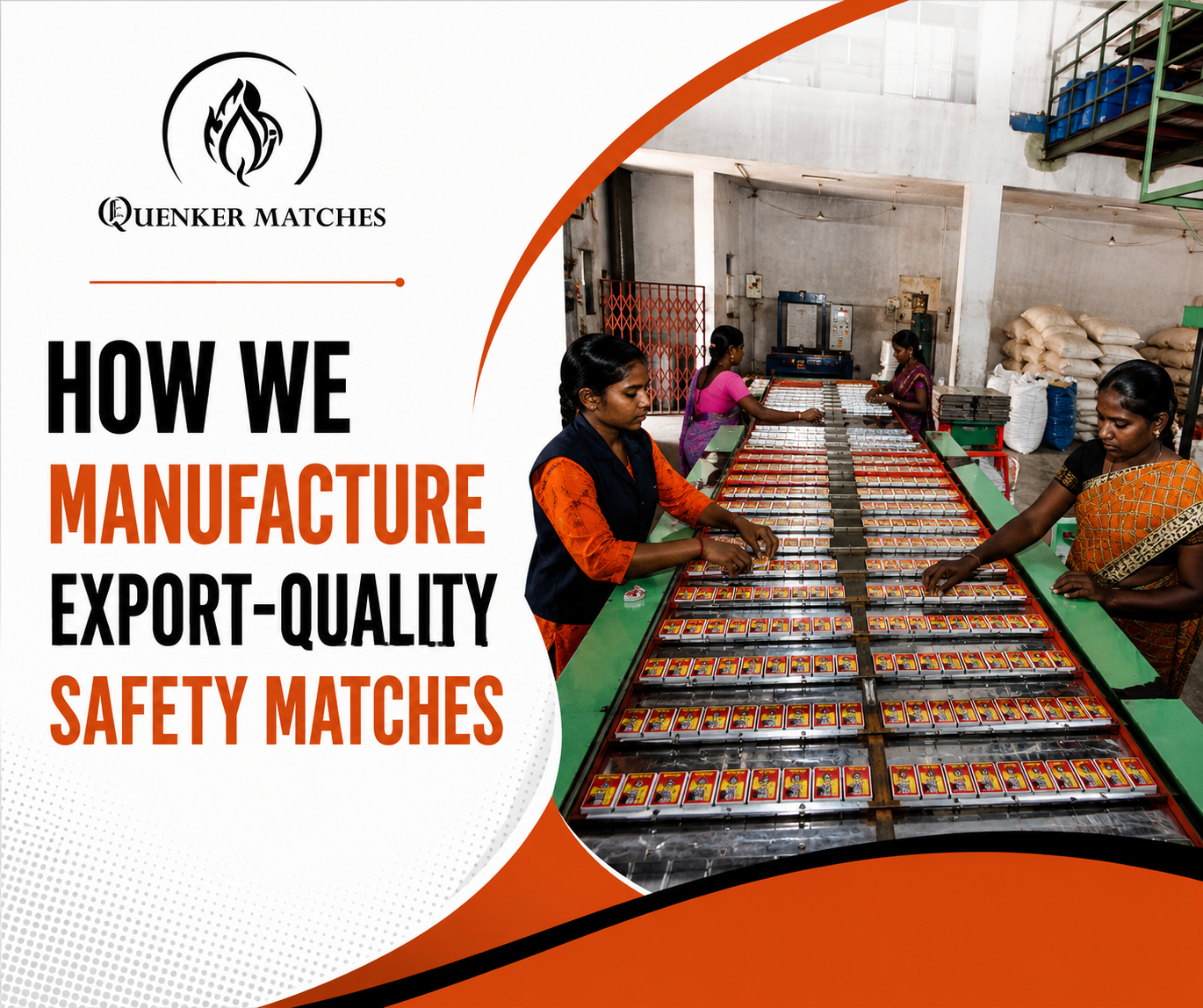
Importers, wholesale distributors, retail chains, and FMCG procurement managers weigh more than price when choosing a safety matches supplier. Product quality shapes customer satisfaction, brand reputation, and long-term business success — which makes the choice of manufacturer a genuinely strategic one.
This article walks through our matchbox manufacturing process, from raw material selection to final export packaging, so buyers can see exactly how we maintain consistency, safety, and quality in every shipment.
What Sets Export-Grade Matches Apart
Local-market matches only need to clear a lower bar. Product bound for international buyers has to hold up to more: durability, ignition performance, packaging integrity, and the rigors of long-distance transport. In practice, that means matches which:
- Ignite reliably, shipment after shipment
- Burn evenly and safely
- Hold up across varying climates
- Arrive intact after extended transit
- Meet international packaging standards
- Support private-label and custom-branding needs
Hitting all six takes a tightly controlled process with quality checks built in at every stage — not just at the end.
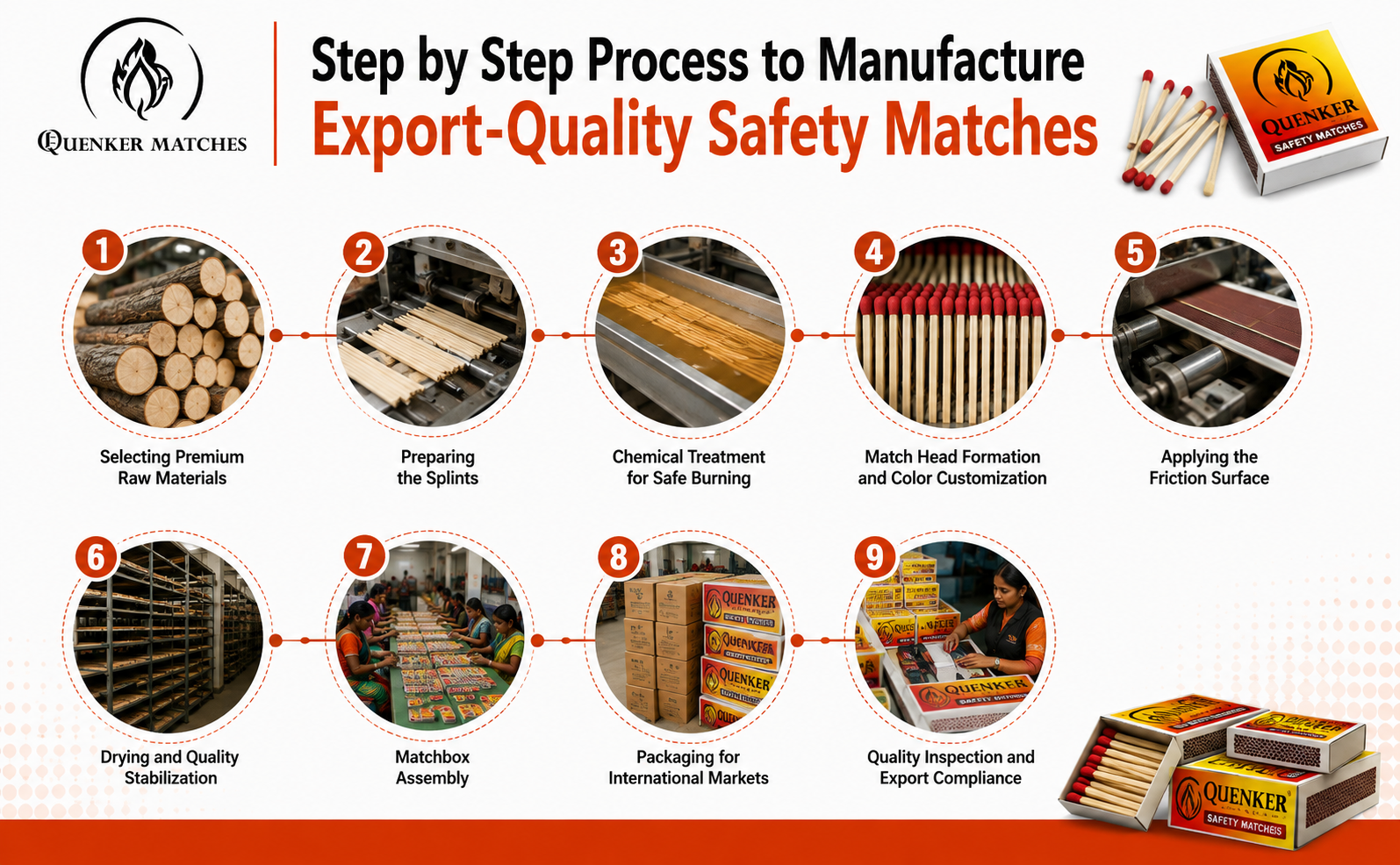
Step 1: Selecting Premium Raw Materials
Everything starts with the wood. At Quenker Matches, we source splints and packaging materials chosen specifically for how they perform, not just how they look. The wood grade directly affects strength, burn consistency, and the end user’s experience.
Splints commonly come from:
- Aspen
- White pine
- Indian Malabarica
- Imported Poplar
Each is selected for uniform grain, a clean finish, controlled burning behavior, and durability. Quality duplex boards and packaging materials round out the raw material stage, giving the product structural strength that carries through storage and transport.
Step 2: Preparing the Splints
Once materials are sourced, splints move into cutting and finishing. Uniform dimensions matter here — inconsistent splints break more easily and burn less predictably. The stage covers:
- Precision cutting to exact dimensions
- Surface finishing for a smooth texture
- Sorting out defective pieces
- Confirming uniform size and shape
This is where manufacturing precision pays off downstream — consistent splints mean consistent flame performance and a cleaner-looking finished box.
Step 3: Chemical Treatment for Safe Burning
Safety is engineered in, not left to chance. Splints are treated with an ammonium phosphate solution that controls burn speed, cuts down afterglow, limits flame spread, and improves overall safety performance.
Treated splints are then dried under controlled conditions so the chemical absorbs evenly — a step that gives the finished match predictable, reliable ignition, which matters most in export markets where buyers can’t inspect every stick themselves.
Step 4: Match Head Formation and Color Customization
The match head is where ignition actually happens, so its formulation and coating get close attention. Each splint is coated and processed under controlled conditions to deliver consistent ignition, controlled flame, reliable striking, and a uniform look.
For branding and regional preference, heads are available in:
- Red
- Black
- Brown
- Blue
- Green
- Yellow
This range lets importers and distributors tailor products to local consumer preferences or private-label requirements without changing suppliers.
Step 5: Applying the Friction Surface
A match head means nothing without a friction strip that works. The strip along the box side has to strike smoothly and consistently, batch after batch — inconsistency here is one of the most common causes of ignition failures and poor customer experience.
As a long-standing matchbox exporter from India, we treat friction-surface quality as a non-negotiable checkpoint, not an afterthought.
Step 6: Drying and Quality Stabilization
After head coating and friction application, products go through controlled drying that stabilizes the chemical composition, prevents moisture retention, extends storage life, and locks in ignition consistency. Temperature and humidity are monitored throughout.
This step matters most for exports — products can sit in transit for weeks before reaching an end user, and proper drying is what keeps performance reliable no matter the climate they pass through.
Step 7: Matchbox Assembly
With matchsticks ready, production shifts to box assembly: inner box production, outer sleeve manufacturing, friction strip application, matchstick insertion, and final assembly — all built for accuracy at volume.
Every assembled box is checked for proper fit, smooth sliding action, accurate match count, and visual consistency, since these are the details a customer notices first.
Step 8: Packaging for International Markets
Export shipments travel far and pass through many hands, so packaging has to protect the product while still doing its job as a brand asset. We offer:
- Custom printed matchboxes
- Private label packaging
- Distributor branding
- Retail-ready packaging
- Bulk export cartons
Good packaging prevents transit damage, keeps the product intact, simplifies warehousing, and improves shelf appeal — which is why flexible packaging options are one of the main reasons importers choose to work with us.
Step 9: Quality Inspection and Export Compliance
Quality control runs through the entire process, following internationally recognized quality management practices such as the ISO 9001 Quality Management System.
Catching issues early, at each stage, is what keeps shipment-to-shipment variation low and gives buyers supply they can depend on.
Manufacturing at a Glance
| Manufacturing Stage | Purpose |
| Raw Material Selection | Ensure durability and reliable performance |
| Splint Preparation | Create uniform, strong matchsticks |
| Chemical Treatment | Improve safety and controlled burning |
| Match Head Coating | Enable consistent ignition |
| Friction Surface Application | Ensure reliable striking performance |
| Drying Process | Stabilize product quality |
| Matchbox Assembly | Produce durable, functional matchboxes |
| Export Packaging | Protect products during transportation |
| Final Quality Inspection | Verify consistency and export readiness |
Why Importers Choose Quenker Matches
Specifications only tell part of the story — buyers also need confidence that a supplier can deliver the same quality shipment after shipment. That trust is built on:
- Over four decades of manufacturing experience
- Daily production capacity of roughly 2 million matchboxes
- Consistent, export-focused quality control
- Flexible packaging and private-label customization
- Dependable global supply support
The Bottom Line
Manufacturing export-quality safety matches takes more than good intentions — it takes premium raw materials, disciplined production, rigorous inspection, and packaging built for the realities of international shipping. Every stage described here exists to protect one thing: consistency, shipment after shipment.
For buyers evaluating suppliers, understanding this process is a useful lens for separating experienced manufacturers from the rest.
Looking for a Trusted Export Partner for Safety Matches?
Quenker Matches brings together manufacturing expertise, quality-first production, large-scale capacity, and customizable packaging to deliver export-quality safety matches for global markets.
Whether you’re an importer, wholesale distributor, retail chain, or FMCG procurement manager, our team can put together a matchbox solution built around your market’s requirements.
Source high-quality safety matches with customized packaging and dependable export support — enquire today.
