Author: quenker-editor

Blog

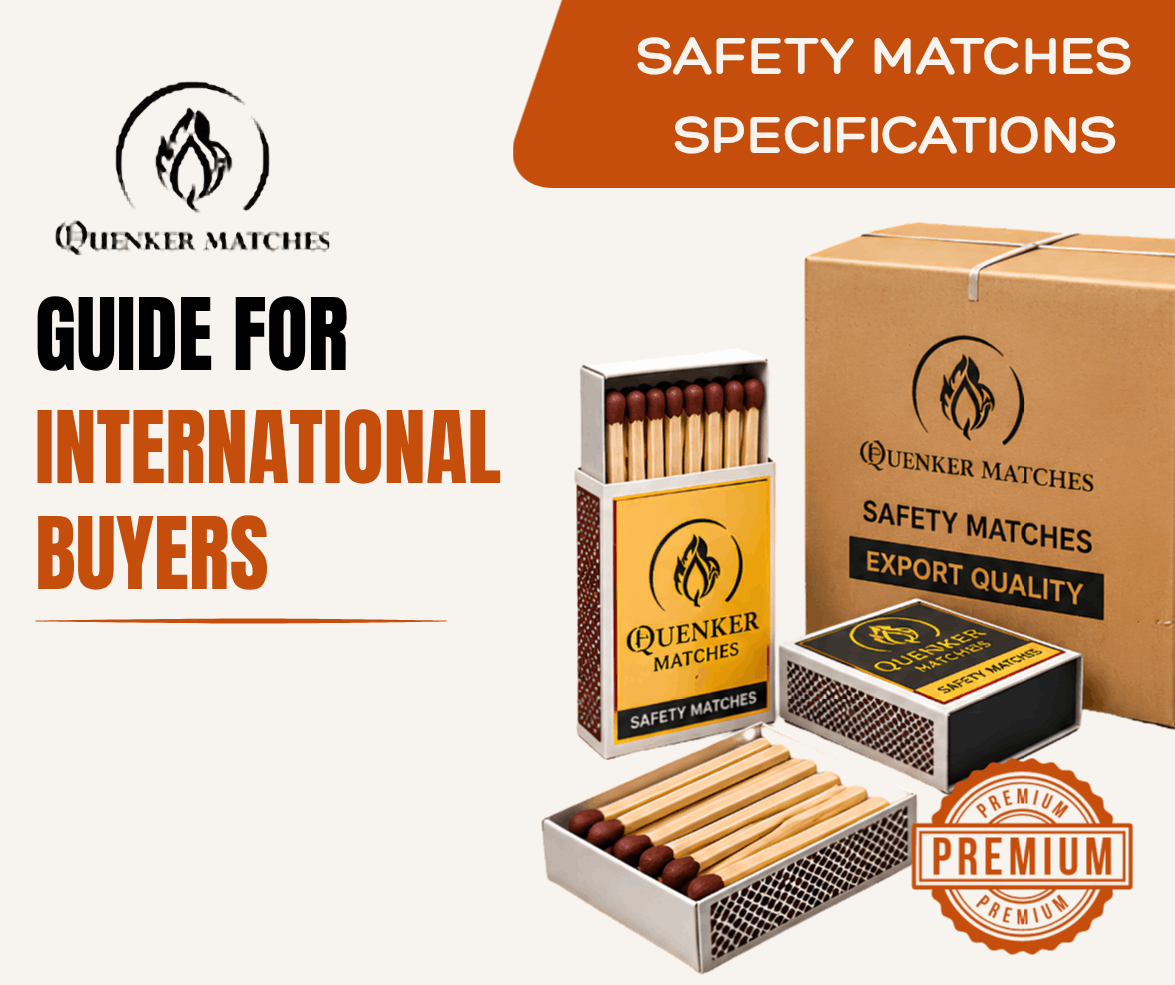
Safety Match Specifications: A Complete Guide for International Buyers

Introduction
When you source safety matches for your market — whether you’re stocking supermarket shelves, supplying corner shops, or distributing to rural households — product specifications matter. The wrong match head composition, incorrect box dimensions, or non-compliant labelling can cost you shipments, customers, and market access.

This guide is designed for international buyers who want a clear, technical, and practical understanding of what to look for when sourcing safety matches from Quenker.

We export to markets across the Middle East, Africa, and South America, serving buyers in Saudi Arabia, Yemen, the United Arab Emirates, Sudan, Nigeria, South Africa, and Peru, among others. Our specifications are engineered to meet the regulatory, climatic, and consumer requirements of each of these regions.
What Are Safety Matches? A Quick Primer
Safety matches are matches that can only be ignited when struck against a specially prepared surface – typically the striker strip on the side of the matchbox. Unlike “strike-anywhere” matches, safety matches require the chemical reaction between the match head and the striker to initiate combustion. This two-part design makes them significantly safer for household and commercial use.
Match Head Composition & Standards
The match head is the most chemically sensitive part of the product and is the primary focus of international safety standards. At Quenker, we formulate our match heads using a carefully balanced composition that ensures consistent ignition, clean burn, and compliance with global regulations.
1. Standard Match Head Composition

Component
Role
Typical % Range

Potassium Chlorate
Oxidising agent
40 – 55%

Sulphur
Fuel / ignition aid
5 – 15%

Antimony Trisulphide
Friction fuel
5 – 10%

Animal Hide Glue
Binder
10 – 20%

Fillers (chalk, diatomite)
Consistency & colour
10 – 20%

Colourants & Dyes
Identification / branding
1 – 3%

Note: Phosphorus sesquisulphide formulations are available upon request for markets that restrict chlorate compositions. Quenker Matches can adapt formulations to meet local chemical safety legislation.
2. Key Quality Indicators for Buyers

Consistent ignition on first strike — minimum 95% success rate in standard conditions
No after-glow — the match head should stop burning cleanly with no smouldering ember
No excessive sparking or spit — critical for use near flammable goods
Stable shelf life — minimum 3 years from manufacture date under correct storage conditions

Match Stick (Splint) Specifications
The splint determines the burn duration, ease of handling, and structural integrity of the match. Our standard and custom splint options are detailed below.

Specification
Standard Option
Economy Option

Material
Aspen / Poplar Wood
Wax-impregnated cardboard

Length
43 mm
40 – 45 mm (custom)

Diameter
2.0 – 2.2 mm
N/A (flat card)

Treatment
Paraffin impregnated
Paraffin coated

Burn Time
15 – 20 seconds
10 – 15 seconds

Moisture Content
< 12%
< 10%


Buyer Tip: Choosing the Right Splint for Your Market

Wood splints are preferred in Saudi Arabia, UAE, and South Africa — consumers associate them with quality and reliability.
Cardboard/booklet matches perform well in Nigeria, Kenya, and Sudan where price sensitivity is high and single-use convenience matters.
Peru and Zambia have shown strong preference for wood splints in rural distribution channels, while urban buyers accept cardboard.
 Yemen buyers typically source standard wood splints — we recommend 43 mm as the default for this market.

Matchbox Dimensions & Packaging Formats
Quenker offers multiple box formats to suit retail, wholesale, and industrial buyers across all our export markets. Standard dimensions comply with ISO packaging guidelines, with custom sizes available for private label and bulk buyers.

Format
Box Size (mm)
Match Count
Best For

Household Small
50 × 35 × 15
40 matches
Retail — Nigeria, Kenya, Yemen

Household Standard
57 × 38 × 17
50 matches
Retail — Saudi Arabia, UAE, Peru

Household Large
64 × 42 × 19
70 – 80 matches
Wholesale — South Africa, Sudan

Long Matches
150 × 38 × 20
45 matches
Candles/BBQ — Global

Booklet Matches
55 × 40 (folded)
20 matches
Nigeria, Kenya, Zambia

 All boxes are manufactured from SBS (Solid Bleached Sulphate) board for the outer sleeve and grey chipboard for the inner tray. Custom printing is available in up to 4-colour CMYK offset, with varnish or laminate finish options.
Striker Strip Specifications
The striker strip is the ignition surface applied to one or both sides of the outer matchbox. Its formulation must be precisely balanced — too little friction agent and matches won’t light; too much and the strip degrades rapidly or causes excessive sparking.

Parameter
Specification

Primary Composition
Red Phosphorus (25–30%), Antimony Trisulphide, Abrasives

Abrasive Agent
Ground glass or silicon carbide

Binder
Animal glue or synthetic binder

Strip Width
12 – 15 mm (standard); custom widths available

Application
One or two sides of box

Minimum Strikes
≥ 60 successful ignitions per strip

Humidity Resistance
Functional up to 80% relative humidity

 For buyers in high-humidity markets such as Nigeria (coastal regions), Kenya, and parts of Yemen, we offer moisture-resistant striker strips with enhanced binder ratios. This is particularly important for goods stored in non-climate-controlled warehouses.
Regulatory Compliance by Export Market
One of the most complex aspects of international match sourcing is navigating the regulatory landscape. Below is a summary of key compliance considerations for Quenker’s primary export markets.
1. Saudi Arabia & United Arab Emirates
The Gulf Cooperation Council (GCC) countries follow SASO (Saudi Standards, Metrology and Quality Organisation) and ESMA (Emirates Authority for Standardisation and Metrology) standards respectively. Key requirements include:

Arabic labelling on packaging (at minimum bilingual: Arabic + English)
SASO/ESMA conformity certificate required for customs clearance
No white phosphorus compounds — strictly prohibited
Pallet specifications: 1200 × 1000 mm (EUR pallet), heat-treated wood (ISPM 15)
Halal-compliant binders preferred — animal glue sourced from halal-certified suppliers

2. Yemen
Yemen follows a simplified import standard framework given ongoing market challenges.

Key requirements:

Port of entry: Aden — documentation must include certificate of origin (India/approved countries)
Standard household formats (50-match boxes) are the dominant retail SKU
Price competitiveness is the primary purchase driver — economy splints are acceptable
Arabic-only labelling is common for domestic distribution

3. Sudan
Sudan imports are regulated under SSMO (Sudanese Standards and Metrology Organisation):

Arabic labelling mandatory; English secondary
Moisture content of splints must not exceed 12% on arrival — critical for this climate
Large-format boxes (70–80 matches) are preferred by the wholesale sector
SSMO product registration may be required for first-time importers

4. Nigeria
Nigeria is regulated by the Standards Organisation of Nigeria (SON) and NAFDAC for specific product categories:

English labelling (official language) required
SON Import Inspection Scheme (SONCAP) certificate required for customs
Both wood and booklet match formats move well — Lagos and urban markets prefer standard boxes
Tropical packaging protection essential — humidity can reach 90%+ in southern regions

5. South Africa
South Africa follows SANS (South African National Standards), specifically SANS 1303:

English and Afrikaans labelling standard
NRCS approval required
Child-resistant packaging regulations apply to certain match product categories
Strong preference for quality wood splints; consumers are brand-loyal

6. Zambia
Zambia Compulsory Standards Agency (ZCSA) governs import standards:

ZCSA import permit required; product must meet ZS (Zambia Standard) specifications
English labelling (official language of commerce)
Both rural cooperative and urban retail channels are active buyers
Competitive pricing is key — Zambia is price-sensitive; we recommend standard economy wood splints

7. Kenya
Kenya Bureau of Standards (KEBS) governs match imports under KS 1246:

Pre-export verification of conformity (PVoC) required — third-party inspection at origin
English and Swahili labelling encouraged for retail formats
Booklet matches and small household boxes are the most common retail SKUs
KEBS import standardisation mark (Diamond Mark) may be required for market access

8. Peru
Peru follows INDECOPI standards and Ministry of Production regulations:

Spanish labelling mandatory on all consumer packaging
SENASA and DIGESA may have jurisdiction depending on chemical composition declarations
Standard 50-match household boxes dominate the retail channel
Port of entry: Callao — all documentation must be in Spanish or officially translated
Peru is a growing export market for Quenker — strong demand from supermarket chains and HORECA

Packaging, Labelling & Private Label Options
Quenker Matches offers full private label capability for buyers who wish to sell under their own brand. We handle design, printing, and packaging in-house, reducing lead times and ensuring quality control at every step.
Standard Label Requirements

Brand name and logo
Match count per box
Manufacturer name and country of origin (India)
Safety warnings (language-appropriate)
Flammable goods symbol (UN GHS flame pictogram)
Batch/lot number and manufacturing date
Storage instructions: keep dry, away from heat and children

Private Label Minimum Order Quantities

Format
MOQ (Cartons)
Lead Time

Standard Household Box (50 matches)
500 cartons
21 – 28 days

Long Matches / BBQ
300 cartons
25 – 35 days

Booklet Matches
800 cartons
18 – 25 days

Custom Size / Special Format
1,000 cartons
30 – 45 days

Each carton typically contains 50 × 12 = 600 boxes (standard format), or as agreed per buyer specification. Pallet quantities and FCL (Full Container Load) pricing available on request.
Quality Control & Testing Protocols
Quenker Safety Matches infrastructure is highly advanced and quality-focused. Every batch produced by Quenker undergoes a rigorous multi-stage quality control process before dispatch. Our internal QC laboratory tests each production run based on the following parameters:

Test
Standard / Method
Pass Threshold

Ignition Success Rate
ISO 4637 / internal protocol
≥ 95% on first strike

After-Glow Test
EN 1783
No after-glow > 5 seconds

Moisture Content (Splint)
ASTM D4442
< 12%

Splint Tensile Strength
Internal pull-test
> 8N per splint

Striker Strip Durability
60-strike minimum test
≥ 60 successful ignitions

Box Compression Test
ISTA 1A
No deformation at 10 kg load

Humidity Resistance (Head)
72hr @ 80% RH
Ignition success ≥ 90%

Shelf Life Verification
Accelerated aging test
3-year minimum stability

Shipping, Hazardous Goods Classification & Documentation
Safety matches are classified as dangerous goods under international transport regulations. Buyers must be aware of the correct classification to ensure smooth customs clearance and avoid shipment delays.
1. UN Classification

UN Number: UN 1944 (Matches, safety)
Hazard Class: 4.1 — Flammable Solids
Packing Group: II or III depending on format
Proper Shipping Name: MATCHES, SAFETY

2. Standard Shipping Documentation

Commercial Invoice (English + destination language if required)
Packing List
Certificate of Origin (Chamber of Commerce certified)
Material Safety Data Sheet (MSDS/SDS) — provided by Quenker for every product
Dangerous Goods Declaration (DGD) — for sea and air freight
Phytosanitary Certificate — for wood splint products (ISPM 15 compliance)
Pre-shipment inspection certificate — where required by destination country

 
Important: Port & Regulatory Notes by Market

Saudi Arabia (Jeddah/Dammam): SASO conformity certificate must accompany shipment — obtain before loading.
Nigeria (Apapa/Tin Can): SONCAP certificate issued by approved verification body — apply 4–6 weeks in advance.
Kenya (Mombasa): PVoC inspection at origin port required — book third-party inspector early.
South Africa (Durban): NRCS approval number must appear on packaging label.
Peru (Callao): All documents to be in Spanish or notarised translation.
Yemen (Aden): Certificate of Origin must state country of manufacture clearly; ensure HS code accuracy.
Sudan (Port Sudan): SSMO product registration recommended for repeat importers.
Zambia (Lusaka/Dar es Salaam transit): ZCSA import permit required prior to shipment.
UAE (Jebel Ali): ESMA conformity mark — coordinate with local importer for registration.
Zambia, Nigeria, Kenya: Tropical packaging (moisture-barrier inner lining) strongly recommended.

Storage & Handling Recommendations
Proper storage is critical for maintaining match quality from our factory to your end consumer. These guidelines apply to our buyers’ warehouses in all export markets.

Store in a cool, dry environment — ideal temperature: 10°C to 30°C
Relative humidity: below 65% — critical in tropical markets (Nigeria, Kenya, Zambia, Peru coastal)
Keep away from direct sunlight, heat sources, and open flames
Do not store near petroleum products, solvents, or acids
Stack pallets no more than 3 high to avoid box compression and deformation
First In, First Out (FIFO) stock rotation — shelf life is 3 years from manufacture
In high-humidity markets, consider climate-controlled storage — especially for striker-strip integrity

Why International Buyers Choose Quenker Matches
With over a decade of export experience and a dedicated focus on emerging and developing markets, Quenker Exports has built a reputation for reliability, compliance, and customer-centric service. Here is what sets us apart:

Capability
Details

Export Markets
Saudi Arabia, UAE, Yemen, Sudan, Nigeria, South Africa, Zambia, Kenya, Peru & more

Annual Capacity
Over 500 million matchboxes per year

Certifications
ISO 9001:2015 | CE | GCC / SASO ready | SONCAP listed

Private Label
Full design, printing & custom packaging in-house

Lead Times
18 – 45 days (format & volume dependent)

Minimum Order
300 cartons (standard formats); 1,000 for custom

Payment Terms
T/T, LC at sight, DA/DP negotiable for established buyers

Inspection
SGS / BV / Intertek pre-shipment available

Language Support
English, Arabic, French, Spanish documentation

How to Place an Order with Quenker Matches
Quenker Matches is a leading safety matches exporter and manufacturer in India. Getting started with Quenker is straightforward. Follow these steps to go from enquiry to shipment:

Send us your requirement: Box format, quantity, destination country, labelling requirements (private label or standard).
Receive a quotation: We respond within 24–48 business hours with a proforma invoice including unit price, carton dimensions, weight, and shipping estimate.
Sample approval: Pre-production samples available for new buyers and private label orders.
Confirm order & advance payment: Production begins upon receipt of agreed advance or LC.
Pre-shipment inspection & documentation: All certificates, DGD, and compliance documents issued before loading.
Shipment & tracking: Full bill of lading, container tracking, and post-shipment support provided.

Ready to Source Safety Matches for Your Market? Contact Quenker Matches today for product samples, and export support for your target market.

Posted by quenker-editor
Blog

How to Find a Reliable Safety Matches Wholesale Supplier in Saudi Arabia

Introduction
Saudi Arabia’s FMCG sector is expanding at a remarkable pace, driven by robust retail infrastructure, surging hospitality demand, and a growing appetite for private-label sourcing. According to industry estimates, the GCC FMCG market is projected to surpass $60 billion by 2027, with everyday consumables like safety matches forming a critical, high-velocity segment.

For importers, distributors, and wholesale traders, finding the right safety matches wholesale supplier in Saudi Arabia goes far beyond comparing prices. It means ensuring product compliance, supply chain reliability, and long-term partnership value — all within one of the Middle East’s most regulated import environments.
Why Safety Matches Are a Staple FMCG Product in Saudi Arabia
1. Consistent Demand Across Retail, Hospitality, and Industrial Sectors
Safety matches are consumed daily across households, restaurants, hotels, catering operations, and industrial kitchens throughout the Kingdom. Major supermarket chains, wholesale distributors, and food service companies require uninterrupted supply — making FMCG wholesale matches in Saudi Arabia a stable, recurring procurement priority rather than a seasonal category.
2. Role of Matches in Everyday Consumer Use
From lighting stoves to candles, incense, and grills, safety matches are an essential utility product. Their affordability and ease of use ensure constant demand across both urban and rural markets in the Kingdom of Saudi Arabia.
3. Market Opportunities for Distributors
With expanding retail chains and private-label opportunities, importers looking to buy safety matches bulk Saudi Arabia can capitalize on consistent turnover and strong margins, provided they partner with a reliable supplier.
How to Choose a Safety Matches Wholesale Supplier Saudi Arabia
Selecting the right supplier requires a structured evaluation process. Not all suppliers offer the same level of quality, compliance, or service.
Importance of Working with a Reliable Matches Supplier
Partnering with a dependable matches supplier guarantees uniform product quality, reduces customer complaints and returns, and safeguards your brand image while ensuring smooth operations in Saudi Arabia’s highly competitive FMCG distribution market.
Key Criteria to Evaluate a Supplier
1. Certifications and Compliance
Always verify that the supplier provides SASO certified safety matches — certification from the Saudi Standards, Metrology and Quality Organization is non-negotiable for legal import into the Kingdom. Additionally, look for ISO 9001 quality management certification, which signals process consistency across production batches. Suppliers without verifiable certification documents should be eliminated from consideration immediately, regardless of pricing.
2. Minimum Order Quantity (MOQ)
Not every distributor operates at the same scale. Some exporters impose rigid high-MOQ requirements that strain cash flow, especially for new market entrants. Prioritize suppliers who offer tiered MOQ structures, allowing you to start with trial quantities and scale as your distribution network grows.
3. Sample Availability and Testing
Always request a product sample before placing a bulk order. Evaluate the sample across four key parameters:

Ignition consistency — does every match light reliably on the first strike?
Burn duration — is the flame stable and sufficient for intended use?
Breakage rate — are matchsticks structurally sound under normal handling?
Packaging integrity — does the matchbox stay sealed and protected during transit?

4. Export Experience to GCC Markets
Work with a wholesale matchbox supplier with GCC export experience who understands the nuances of Saudi customs, SASO conformity requirements, and regional labeling mandates. An experienced exporter will proactively manage CoC (Certificate of Conformity), origin certificates, and shipping documentation without placing that burden on the buyer.

5. Delivery Timelines and Logistics Capability
Clarify shipping terms before signing any agreement. FOB (Free on Board) means the supplier is responsible until goods are loaded at the origin port; CIF (Cost, Insurance, Freight) means they cover delivery to the Saudi destination port. Understand which applies, confirm lead times in writing, and ask for references from existing GCC clients to verify delivery track record.
SASO and SFDA Compliance: What Every Importer Must Know
The Saudi Standards, Metrology and Quality Organization (SASO) regulates product safety standards. SASO certified safety matches must meet strict criteria for ignition safety, chemical composition, and packaging standards.
SFDA Guidelines for FMCG Imports
The Saudi Food and Drug Authority (SFDA) oversees consumer product safety. While matches are not food items, they still fall under general product safety and labeling regulations.
Documentation Required to Import Safety Matches Saudi Arabia
To import safety matches Saudi Arabia, you typically need:

Certificate of Conformity (CoC)
Commercial Invoice & Packing List
Bill of Lading
Country of Origin Certificate
Product testing reports (if required)

Packaging and Labeling Requirements for the Saudi Market
1. Arabic Labeling Is Mandatory
All safety match products sold in Saudi Arabia must carry Arabic labeling including the product name, intended use, manufacturer or importer name and address, country of origin, and relevant safety instructions. Products arriving without compliant Arabic labels can be held at customs or refused entry entirely.
2. Safety Warnings and Fire Hazard Instructions
Clear fire hazard warnings and safe storage instructions must appear prominently on all packaging. This protects consumers, reduces liability risk for distributors, and satisfies Saudi regulatory inspection requirements.
3. Pack Formats Suited for the Saudi Distribution Market

Pack Format
Best For

10-match small box
Hospitality / hotel amenities

40–50 match standard box
Household retail

6-box or 10-box multi-pack
Supermarket shelf display

Master carton (bulk)
Wholesale distributors

Private-label custom packaging
Importer brand building

Suppliers offering private-label packaging customization are particularly valuable for importers looking to build their own brand equity in the Saudi market.
Common Mistakes When Choosing a Matches Supplier

Mistake 1: Accepting Unverified Certification Claims
Never accept verbal assurances about SASO compliance. Always request original certification documents and verify them with the issuing body. Importing non-compliant products risks port rejection, financial loss, and reputational damage.
Mistake 2: Ignoring Product Quality Signals
Watch for these warning signs in supplier samples: excessive matchstick breakage, inconsistent strike rates, phosphorus odor from packaging, or poorly sealed matchboxes. These signal manufacturing shortcuts that will generate customer complaints in the field.
Mistake 3: Overlooking Total Landed Cost
Many importers focus only on unit price and miss the total landed cost — which includes freight, customs duties (typically 5–15% in KSA for FMCG goods), port handling, and last-mile delivery. Always calculate landed cost per carton before comparing suppliers.
Mistake 4: No Sample Policy or Poor Communication
A supplier who refuses samples or responds slowly to inquiries is demonstrating exactly how they will behave post-order. Communication responsiveness during the pre-sale phase is one of the strongest predictors of long-term supplier reliability.
Domestic vs. Imported Safety Matches

Criteria
Domestic Suppliers (KSA)
Imported Suppliers (India/GCC)

Cost
Higher production cost
Competitive pricing

Quality
Limited variety
Consistent, export-grade quality

Compliance
Easier local compliance
Requires SASO certification

Lead Time
Faster
Depends on shipping

Customization
Limited
High (private label options)

Why Many Buyers Prefer Imports
Many distributors prefer working with a safety matches distributor Middle East network that sources from experienced exporters, offering better pricing and scalable supply.
Why Indian Manufacturers Are the Preferred Source for Bulk Safety Matches
1. Industry-Scale Production Capability
India accounts for a significant share of global safety match production, with the Kovilpatti region of Tamil Nadu recognized internationally as a manufacturing hub for high-quality safety matches. Factories in this region operate under stringent quality controls, producing export-grade matches that meet international safety standards consistently at scale.
2. Competitive Pricing for Bulk Orders
Indian exporters offer significant cost advantages for buyers looking to buy safety matches bulk Saudi Arabia, thanks to efficient production systems, skilled labor, and economies of scale.
3. Trusted Supply Chain for Middle East
Partnering with an experienced wholesale matchbox supplier GCC ensures smooth logistics, proper documentation, and timely delivery, making them a dependable safety matches distributor Middle East businesses trust.
Why Partner with Quenker Matches for Safety Matches Supply to Saudi Arabia
Importers and distributors across the Middle East choose Quenker Matches because we solve the core challenges of bulk safety match procurement:

SASO certified safety matches — fully compliant for Saudi import
Flexible MOQ — suitable for both growing distributors and large-scale buyers
Custom private-label packaging — Arabic-compliant designs available
Reliable GCC logistics — established freight corridors to Jeddah and Dammam
Complete documentation support — CoC, origin certificates, and customs paperwork handled
Dedicated export team — responsive, experienced in Saudi regulatory requirements

With manufacturing rooted in India’s premier match-producing region, Quenker delivers export-grade quality with the consistency that long-term distribution relationships demand.
Ready to source? Request your bulk quote today and receive a sample shipment within a few business days.
FAQ’s
1. How do I verify a safety matches supplier is reliable for Saudi Arabia?
Check SASO certification and validate it with the authority. Ask for GCC client references, request samples, and evaluate communication. Reliable suppliers like Quenker Matches provide clear documentation, transparent pricing, and strong knowledge of Saudi regulations.
2. What does SASO certification mean for safety matches?
SASO certification ensures compliance with Saudi safety, quality, and labeling standards, including chemical limits, ignition safety, packaging strength, and Arabic labeling. Without it, shipments risk rejection at customs.
3. What is the minimum order quantity for bulk safety matches to Saudi Arabia?
MOQ varies by supplier. Many exporters offer flexible options, starting from trial orders to full container loads. It’s best to begin with a smaller order to test quality before scaling. Suppliers like Quenker Matches often provide flexible MOQ options for different business needs.
4. What documents are required to import matches into Saudi Arabia?
Key documents include Certificate of Conformity, commercial invoice, packing list, bill of lading, country of origin, and testing reports. Missing documents can delay or block shipments.
5. Why do Saudi importers prefer Indian safety match manufacturers?
Indian manufacturers offer competitive pricing, consistent quality, scalable production, and strong export experience, making them reliable long-term suppliers for Saudi importers.
Final Thoughts
Sourcing safety matches for the Saudi Arabian market is a compliance-sensitive, relationship-driven procurement process. From SASO certification and Arabic labeling to logistics reliability and supplier credibility, every factor in your evaluation directly impacts your distribution performance and brand reputation.

Whether you are a first-time importer or an established FMCG distributor scaling your product range, partnering with a proven safety matches wholesale supplier in Saudi Arabia with genuine GCC export experience is the foundation of long-term success in this essential commodity market.
Connect with Quenker Matches today — request your wholesale quote and product samples to get started.

Posted by quenker-editor
Blog Safety Matches

5 Key Differences Between Quenker Matches and Other Safety Matches

Introduction
When choosing a safety matches wholesale supplier, the difference between a reliable partner and a low-quality manufacturer isn’t always visible on a product sheet. It shows up in failed ignitions, moisture-damaged stock, customs rejections, and frustrated end customers.

This guide breaks down five concrete, verifiable differences between Quenker Matches and typical competitors — backed by specifics on materials, certifications, and export experience — so wholesale buyers, distributors, and importers can make confident, data-driven sourcing decisions.
What should you check in a safety matches wholesale supplier?
A reliable safety matches wholesale supplier should offer consistent raw materials, strong ignition performance, moisture-resistant packaging, export certifications like ISI and MSDS, and a proven track record in global markets.

Difference 1: Raw Material Quality in a Safety Matches Wholesale Supplier
What Quenker Uses
Quenker Matches sources two primary wood types for its splints: Malai Vembu (Indian Neem) and imported Poplar. Both are chosen for their uniform grain, low moisture absorption, and clean burn characteristics. Splints are treated with ammonium phosphate — a fire retardant — to slow burn rate and improve safety.

Each batch goes through:

Log debarking and chemical treatment against fungal and insect damage
Precision-cut splints polished to remove rough edges and ensure uniform sizing
Wax dipping to create a moisture barrier before chemical head application
Controlled drying chambers where temperature and humidity are monitored

The Problem With Inconsistent Suppliers
Many Indian match manufacturers source wood opportunistically, leading to variation in stick diameter, density, and moisture content across batches. This directly causes breakage during striking, uneven chemical coating, and ignition failure rates that are difficult to predict at scale.

For matchbox wholesale buyers ordering container loads, a 3–5% defect rate in a 20-foot container is not a minor inconvenience — it means thousands of unusable units and potential customer returns.
Difference 2: Single-Strike Ignition vs. Repeated Failure
The Chemistry Behind Reliable Ignition
A safety match ignites through a controlled reaction between the match head and the striking surface. Quenker’s match heads use a precisely balanced composition of potassium chlorate (oxidizing agent), sulfur and antimony sulfide (combustion fuel), powdered glass for friction, and stabilizing binders.

The striking surface on every Quenker matchbox contains red phosphorus — a stable, safer alternative to white phosphorus — combined with powdered glass and binders applied at a controlled thickness.
Why Other Matches Fail
Common ignition failures in standard safety matches stem from two causes: inconsistent phosphorus coating on the striking surface (applied too thin or uneven), and variable match head chemical ratios that produce a flame too weak to sustain.
Note: Request ignition test data or a sample batch test before placing a large wholesale order.
Difference 3: Moisture Resistance in Safety Matches Wholesale Supply
How Quenker Ensures for Humidity
India’s tropical climate — and the export routes Quenker serves (Sub-Saharan Africa, the Middle East, Southeast Asia) — demand products that perform in high-humidity environments. Quenker addresses this at multiple production stages:

Wax-dipped splints create a moisture barrier around the wood before chemical heads are applied
Veneer safety matches are fully moisture-proof 
Cardboard safety matches use fine-grade duplex board that resists humidity-induced warping
Packaging uses moisture-sealed wrapping for export cartons

The Cost of Moisture-Damaged Stock
Standard safety matches that absorb moisture during a 4–6 week ocean transit can arrive with softened splints, degraded striking surfaces, and match heads that crumble rather than ignite. For distributors, this means either writing off stock or passing defective product to retail — neither is acceptable.

Quenker’s veneer matches — made with rubberwood outer casing and duplex board inner box — are specifically marketed on their 100% moisture-proof certification, a claim that can be independently verified.
Difference 4: Export-Grade, Customizable Packaging
Quenker’s Packaging Options
Quenker offers a structured range of packaging configurations designed for both retail and bulk logistics:

10-matchstick packs in blue paper packaging (retail/hotel)
100-matchstick packs in labeled blue paper packaging
1,000-matchstick packs in 3-ply color-printed cartons or brown kraft cartons
Container-load bulk packaging in moisture-resistant wrapping

Matchbox dimensions are customizable across seven standard sizes (from 45×31×14mm to 51×35×14mm) with carton quantities ranging from 2,400 to 3,150 units per carton. Custom branding — including private-label matches printing for hotels, restaurant chains, and retail brands — is available with minimum order quantities starting at one 20-foot container.
Why Packaging Matters for Wholesale Buyers
Packaging failure during transit is one of the leading causes of damaged goods claims in the match trade. Boxes that warp, tear, or allow moisture ingress don’t just hurt the product — they undermine the distributor’s brand credibility with their retail customers.

Basic duplex board packaging with no moisture sealing is common among lower-tier manufacturers. Quenker’s export cartons are engineered to withstand rough container handling and climate variation across shipping routes.
Takeaway: Confirm carton weight limits, stacking specifications, and moisture-sealing details before placing orders for humid-climate destinations.
Difference 5: Certifications Every Safety Matches Wholesale Supplier Must Have
Quenker’s Certification and Process Standards
Quenker Matches holds ISI certification — India’s Bureau of Indian Standards mark — which requires compliance with IS 1504 (safety matches standard). This covers match head chemical composition limits, ignition reliability thresholds, and packaging labeling requirements.

Every batch undergoes ignition testing before shipment. Exporters are provided Material Safety Data Sheets (MSDS) and compliance documentation required by international trade authorities, including shipping declarations for hazardous goods classification.
The Risk of Uncertified Matches
Low-quality matches without consistent certification carry real risks beyond ignition failures:

Uncontrolled flare-ups during the first second of combustion — a common issue with over-dosed match heads
Splint fracture during striking, which can send ignited fragments beyond the intended burn zone
Customs detention or rejection in markets that require MSDS documentation
Liability exposure for distributors if product-related incidents occur in-market

Buyer Takeaway: Always request ISI certification, MSDS documents, and a batch test report before importing.
Safety Matches Wholesale Supplier Comparison: Quenker vs Typical Suppliers
The table below summarizes the key differences across product, process, and commercial factors:

Feature
Quenker Matches
Typical Suppliers

Raw Materials
Malai Vembu (Indian Neem) & Poplar splints, ammonium phosphate treated
Generic softwood, variable treatment standards

Ignition Performance
Single-strike ignition; precise potassium chlorate & sulfur composition
Frequent multi-strike failures; inconsistent chemical coating

Moisture Resistance
Wax-dipped splints + moisture-resistant packaging; 
Standard matches absorb moisture; prone to structural failure

Packaging
Export-grade, customizable (3-ply cartons, branded labels, moisture-sealed wrapping)
Basic duplex board; not suited for long-haul export

Safety & Certification
ISI-certified; batch-level ignition testing before every shipment
Certification varies widely; limited quality checkpoints

Export Experience
Exporting since early 2000s to 15+ countries (UAE, Saudi Arabia, Kenya, South Africa, Chile)
Limited export track record or market-specific customization

How These Differences Play Out for Buyers
For Wholesale Distributors
Distributors working with inconsistent Indian match brands face a common pattern: quality holds for 2–3 container orders, then a bad batch arrives — wrong ignition rate, damaged packaging, or moisture-affected stock. Switching suppliers mid-season disrupts supply chains and damages retailer relationships.

Quenker’s 4-decade manufacturing history (founded 1980) and documented export relationships with buyers in Saudi Arabia, UAE, Kenya, South Africa, Ghana, Nigeria, Vietnam, Sri Lanka, and Chile provide a track record that newer or less established manufacturers cannot match.
For Hotel, Restaurant, and Hospitality Importers
Hotel-branded matches are a high-visibility product. A match that fails to light at a fine-dining table is a brand moment that guests remember. Quenker’s customizable private-label packaging — with match head color options and box print customization — is designed specifically for the hospitality segment, where presentation and reliability must both be delivered.
For Export Market Buyers (Africa, Middle East, Southeast Asia)
Quenker Matches is a leading safety matches wholesale supplier in India, exporting to Africa, the Middle East, and Southeast Asia. Buyers sourcing for tropical markets need moisture-proof products, compliant documentation, and a supplier with established logistics experience. Quenker exports in specialized containers to prevent moisture and heat exposure during transit, and provides all required export documentation including MSDS and shipping declarations.

Why Kovilpatti, Tamil Nadu Is India’s Safety Match Hub
Quenker Matches is based in Kovilpatti, Tamil Nadu — historically India’s largest safety match manufacturing cluster. The region’s concentration of raw material suppliers, skilled labour, and industry expertise creates a supply chain efficiency that manufacturers based elsewhere in India cannot replicate.

This geographic advantage directly benefits wholesale buyers through faster production cycles, lower logistics costs to major Indian export ports, and access to specialized inputs like Malai Vembu (Indian Neem) wood that are regionally sourced.
Conclusion
Choosing the right safety matches wholesale supplier is not just a procurement decision — it’s a long-term business investment. Quenker Matches stands out as a reliable safety matches wholesale supplier with proven export experience, consistent quality, and certified products.
The wrong safety matches wholesale supplier can cost more in returns, damage, and lost customers than any savings on price.

👉 Contact us today to request samples, pricing, or bulk supply details.

Frequently Asked Questions
1. What wood does Quenker use in its matchsticks?

Quenker uses Malai Vembu (Indian Neem) and imported Poplar for splints. Both are treated with ammonium phosphate to slow burn rate and resist moisture. Some product lines use rubberwood for outer casing in veneer matches.

2. Are Quenker matches suitable for humid-climate markets like West Africa or Southeast Asia?

Yes. Quenker’s veneer safety matches are certified 100% moisture-proof. All export product lines use wax-dipped splints and moisture-sealed packaging. The company has established export relationships in Kenya, Ghana, Nigeria, Vietnam, and Sri Lanka.

3. What is the minimum order quantity for Quenker’s matchbox wholesale?

The minimum order typically starts at one 20-foot container, though this varies by product type and destination. Contact Quenker directly for market-specific MOQ details.

4. Does Quenker offer private-label or custom branded matchboxes?

Yes. Quenker offers full customization including box size, match head color, printed labels, and branding. This service is used by hotels, restaurant chains, and retail brands across its export markets.

5. What certifications does Quenker hold?

Quenker holds ISI certification under India’s Bureau of Indian Standards. The company provides MSDS documentation, shipping declarations, and compliance reports for international trade requirements.

6. How to choose a safety matches wholesale supplier?
A good safety matches wholesale supplier should provide consistent quality, moisture resistance, export certifications, and a strong track record in bulk supply.

Posted by quenker-editor
Blog Safety Matches

Popular Matchbox Brand in India: Why Quenker Matches Stand Out

Introduction
India produces over 90% of the world’s safety matches. The match-manufacturing belt of Kovilpatti, Tamil Nadu — often called the “Match Capital of India” — is responsible for a significant share of that global output.

Within that ecosystem, Quenker Matches has become one of the most cited names among importers, wholesalers, and distributors looking for a reliable Indian matchbox brand. Operating since 1980, holding ISI certification, and exporting to 20+ countries across four continents, Quenker represents what a mature, export-ready Indian manufacturer looks like.

This article explains why Quenker stands out as a popular matchbox brand in India — and what specifically makes it a sound choice for B2B buyers.
Overview of the Matchbox Market in India
India’s matchbox industry is a blend of traditional craftsmanship and modern quality standards. Originating in towns like Sivakasi and Kovilpatti in Tamil Nadu, areas historically known for match manufacturing, the sector has grown into a major business that supplies products domestically and globally.

Safety matchboxes are designed to ignite easily on friction surfaces without combusting dangerously. Safety matches in India have become everyday essentials: from lighting stoves, lamps, and candles to use in kitchens, hospitality settings, and outdoor activities. 

With consumers and buyers increasingly conscious about reliability and performance, matchbox manufacturers focus on quality control, safety standards, material selection, and packaging design, all of which influence brand preference and market trust.
What Makes a Matchbox Brand “Popular”?
For retail consumers, popularity means shelf recognition. For B2B buyers — the retailers, wholesalers, and importers who actually move volume — popularity means something different:

Consistency of ignition rate across production batches
Compliance with international safety standards (ISI mark, REACH compliance, etc.)
Export experience and familiarity with documentation requirements (Certificate of Origin, Phytosanitary Certificate, etc.)
Custom branding options for private-label buyers
MOQ flexibility and logistics track record

Quenker Matches has built its reputation specifically on these B2B metrics — not on consumer advertising.
Popular Indian Matchbox Brand: Who Are the First Key Player?
With four decades of industry experience, Quenker Matches has built a reputation for quality consistency, dependable performance, and customer satisfaction, serving wholesalers, distributors, and global partners. Its extensive product range covers:

Cardboard Safety Matches
Wax Safety Matches
Wooden Safety Matches
Kitchen Safety Matches
Veneer Matches
Long BBQ Matches

With a wide range of safety matches in India, including wooden matchsticks and specialty variants, Quenker Matches ranks among the most versatile matchbox brands in India, effectively meeting diverse buyer needs and requirements for quality and reliability.
Why Importers and Wholesalers Choose Quenker
ISI Certification — Non-Negotiable for Serious Buyers
ISI certification (Bureau of Indian Standards) is the mandatory quality mark for safety matches manufactured in India. It confirms the product meets IS:285 standards covering ignition reliability, safety head composition, and packaging requirements. Quenker carries this certification, which is a baseline requirement for many government import tenders and regulated retail markets.
For global buyers, ISI certification (IS:285) is the benchmark that separates export-quality matches from risky inventory.
Private Label and Custom Branding at Scale
Many wholesalers and distributors do not want to sell under a manufacturer’s brand — they want their own label. Quenker offers full private-label customisation: box dimensions, label graphics, stick counts, head colours, and brand name. This is a significant operational capability that smaller manufacturers cannot match, and it’s a primary reason export buyers return for repeat orders.
Export Infrastructure Built Over 40+ Years
Since beginning international exports in the early 2000s, Quenker has developed documented experience with export documentation, containerization (20-foot FCL standard), and destination-country import regulations across Africa, the Middle East, and Latin America. For a first-time importer, this reduces compliance risk substantially.
Eco-Friendly Materials
Quenker uses sustainably sourced Malai Vembu (Neem) and Poplar wood — both fast-growing, renewable species. This is increasingly important for retailers in European and Gulf Cooperation Council markets that require environmental declarations from suppliers.
Export Documentation Experience
Exporting safety matches involves a specific documentation stack: Certificate of Origin (CoO), Phytosanitary Certificate (required for wood products entering most countries), Material Safety Data Sheet (MSDS), ISI certification copies, and destination-specific customs codes. Quenker has been navigating this documentation process since the early 2000s across markets including Saudi Arabia, UAE, Yemen, South Africa, Kenya, Sudan, Chile, and Ukraine.
How Quenker Matches Stand Out Among Matchbox Brands
When comparing matchbox suppliers and safety match manufacturers, the following factors determine product performance and buyer preference:
1. Superior Quality and Consistency
Quenker Matches emphasizes rigorous quality control at every production stage. Each matchstick is designed and tested to ensure steady ignition, uniform burn, and minimal breakage, attributes that matter to wholesalers and bulk buyers who demand consistent product quality.

This commitment to quality is seen across the full product lineup, from basic cardboard matches to long‑stick BBQ and kitchen safety matches, ensuring each box meets buyer expectations for performance.
2. Reliable Ignition Performance
Whether it is a wooden matchstick used for lighting a stove or a damp‑resistant wax safety match, our products are made for easy and reliable ignition. This straightforward functionality is a critical differentiator, especially in utility items where performance consistency builds customer trust.
3. Safety Standards and Compliance
We follow established international safety and quality norms, including ISI certification standards, to ensure that every matchbox delivered is safe for intended use. The importance of compliance is high in safety matches, as poorly manufactured matchsticks can either fail to ignite or pose hazards.
4. Thoughtful Packaging and Presentation
Packaging does not just protect matchsticks, but ensures the moisture resistance, durability, and safe storage. Quenker’s packaging options range from standard pocket matchboxes for household use to branded and customized matchbox designs for corporate buyers and exporters.
Frequently Asked Questions
1. Who is the best safety matches exporter in India?

Quenker Matches, headquartered in Kovilpatti, Tamil Nadu, is one of India’s most established safety match exporters, with documented exports to over 20 countries. The company carries ISI certification, offers private-label production, and has operated continuously since 1980.

2. What certifications should I require from an Indian safety match manufacturer?

At minimum, request ISI Mark certification (Bureau of Indian Standards, IS:285) and a current Certificate of Origin. For wood-product import into most countries, a Phytosanitary Certificate is mandatory. An MSDS (Material Safety Data Sheet) covering the match head composition should also be requested for compliance with destination-country hazardous materials regulations.

3. Does Quenker Matches offer private-label matchboxes?

Yes. Quenker offers full private-label customisation including box dimensio