
Introduction
When you source safety matches for your market — whether you’re stocking supermarket shelves, supplying corner shops, or distributing to rural households — product specifications matter. The wrong match head composition, incorrect box dimensions, or non-compliant labelling can cost you shipments, customers, and market access.
This guide is designed for international buyers who want a clear, technical, and practical understanding of what to look for when sourcing safety matches from Quenker.
We export to markets across the Middle East, Africa, and South America, serving buyers in Saudi Arabia, Yemen, the United Arab Emirates, Sudan, Nigeria, South Africa, and Peru, among others. Our specifications are engineered to meet the regulatory, climatic, and consumer requirements of each of these regions.
What Are Safety Matches? A Quick Primer
Safety matches are matches that can only be ignited when struck against a specially prepared surface – typically the striker strip on the side of the matchbox. Unlike “strike-anywhere” matches, safety matches require the chemical reaction between the match head and the striker to initiate combustion. This two-part design makes them significantly safer for household and commercial use.
Match Head Composition & Standards
The match head is the most chemically sensitive part of the product and is the primary focus of international safety standards. At Quenker, we formulate our match heads using a carefully balanced composition that ensures consistent ignition, clean burn, and compliance with global regulations.
1. Standard Match Head Composition
| Component | Role | Typical % Range |
| Potassium Chlorate | Oxidising agent | 40 – 55% |
| Sulphur | Fuel / ignition aid | 5 – 15% |
| Antimony Trisulphide | Friction fuel | 5 – 10% |
| Animal Hide Glue | Binder | 10 – 20% |
| Fillers (chalk, diatomite) | Consistency & colour | 10 – 20% |
| Colourants & Dyes | Identification / branding | 1 – 3% |
Note: Phosphorus sesquisulphide formulations are available upon request for markets that restrict chlorate compositions. Quenker Matches can adapt formulations to meet local chemical safety legislation.
2. Key Quality Indicators for Buyers
- Consistent ignition on first strike — minimum 95% success rate in standard conditions
- No after-glow — the match head should stop burning cleanly with no smouldering ember
- No excessive sparking or spit — critical for use near flammable goods
- Stable shelf life — minimum 3 years from manufacture date under correct storage conditions
Match Stick (Splint) Specifications
The splint determines the burn duration, ease of handling, and structural integrity of the match. Our standard and custom splint options are detailed below.
| Specification | Standard Option | Economy Option |
| Material | Aspen / Poplar Wood | Wax-impregnated cardboard |
| Length | 43 mm | 40 – 45 mm (custom) |
| Diameter | 2.0 – 2.2 mm | N/A (flat card) |
| Treatment | Paraffin impregnated | Paraffin coated |
| Burn Time | 15 – 20 seconds | 10 – 15 seconds |
| Moisture Content | < 12% | < 10% |
|
Buyer Tip: Choosing the Right Splint for Your Market
|
Matchbox Dimensions & Packaging Formats
Quenker offers multiple box formats to suit retail, wholesale, and industrial buyers across all our export markets. Standard dimensions comply with ISO packaging guidelines, with custom sizes available for private label and bulk buyers.
| Format | Box Size (mm) | Match Count | Best For |
| Household Small | 50 × 35 × 15 | 40 matches | Retail — Nigeria, Kenya, Yemen |
| Household Standard | 57 × 38 × 17 | 50 matches | Retail — Saudi Arabia, UAE, Peru |
| Household Large | 64 × 42 × 19 | 70 – 80 matches | Wholesale — South Africa, Sudan |
| Long Matches | 150 × 38 × 20 | 45 matches | Candles/BBQ — Global |
| Booklet Matches | 55 × 40 (folded) | 20 matches | Nigeria, Kenya, Zambia |
All boxes are manufactured from SBS (Solid Bleached Sulphate) board for the outer sleeve and grey chipboard for the inner tray. Custom printing is available in up to 4-colour CMYK offset, with varnish or laminate finish options.
Striker Strip Specifications
The striker strip is the ignition surface applied to one or both sides of the outer matchbox. Its formulation must be precisely balanced — too little friction agent and matches won’t light; too much and the strip degrades rapidly or causes excessive sparking.
| Parameter | Specification |
| Primary Composition | Red Phosphorus (25–30%), Antimony Trisulphide, Abrasives |
| Abrasive Agent | Ground glass or silicon carbide |
| Binder | Animal glue or synthetic binder |
| Strip Width | 12 – 15 mm (standard); custom widths available |
| Application | One or two sides of box |
| Minimum Strikes | ≥ 60 successful ignitions per strip |
| Humidity Resistance | Functional up to 80% relative humidity |
For buyers in high-humidity markets such as Nigeria (coastal regions), Kenya, and parts of Yemen, we offer moisture-resistant striker strips with enhanced binder ratios. This is particularly important for goods stored in non-climate-controlled warehouses.
Regulatory Compliance by Export Market
One of the most complex aspects of international match sourcing is navigating the regulatory landscape. Below is a summary of key compliance considerations for Quenker’s primary export markets.
1. Saudi Arabia & United Arab Emirates
The Gulf Cooperation Council (GCC) countries follow SASO (Saudi Standards, Metrology and Quality Organisation) and ESMA (Emirates Authority for Standardisation and Metrology) standards respectively. Key requirements include:
- Arabic labelling on packaging (at minimum bilingual: Arabic + English)
- SASO/ESMA conformity certificate required for customs clearance
- No white phosphorus compounds — strictly prohibited
- Pallet specifications: 1200 × 1000 mm (EUR pallet), heat-treated wood (ISPM 15)
- Halal-compliant binders preferred — animal glue sourced from halal-certified suppliers
 2. Yemen
Yemen follows a simplified import standard framework given ongoing market challenges.
Key requirements:
- Port of entry: Aden — documentation must include certificate of origin (India/approved countries)
- Standard household formats (50-match boxes) are the dominant retail SKU
- Price competitiveness is the primary purchase driver — economy splints are acceptable
- Arabic-only labelling is common for domestic distribution
3. Sudan
Sudan imports are regulated under SSMO (Sudanese Standards and Metrology Organisation):
- Arabic labelling mandatory; English secondary
- Moisture content of splints must not exceed 12% on arrival — critical for this climate
- Large-format boxes (70–80 matches) are preferred by the wholesale sector
- SSMO product registration may be required for first-time importers
4. Nigeria
Nigeria is regulated by the Standards Organisation of Nigeria (SON) and NAFDAC for specific product categories:
- English labelling (official language) required
- SON Import Inspection Scheme (SONCAP) certificate required for customs
- Both wood and booklet match formats move well — Lagos and urban markets prefer standard boxes
- Tropical packaging protection essential — humidity can reach 90%+ in southern regions
5. South Africa
South Africa follows SANS (South African National Standards), specifically SANS 1303:
- English and Afrikaans labelling standard
- NRCS approval required
- Child-resistant packaging regulations apply to certain match product categories
- Strong preference for quality wood splints; consumers are brand-loyal
6. Zambia
Zambia Compulsory Standards Agency (ZCSA) governs import standards:
- ZCSA import permit required; product must meet ZS (Zambia Standard) specifications
- English labelling (official language of commerce)
- Both rural cooperative and urban retail channels are active buyers
- Competitive pricing is key — Zambia is price-sensitive; we recommend standard economy wood splints
7. Kenya
Kenya Bureau of Standards (KEBS) governs match imports under KS 1246:
- Pre-export verification of conformity (PVoC) required — third-party inspection at origin
- English and Swahili labelling encouraged for retail formats
- Booklet matches and small household boxes are the most common retail SKUs
- KEBS import standardisation mark (Diamond Mark) may be required for market access
8. Peru
Peru follows INDECOPI standards and Ministry of Production regulations:
- Spanish labelling mandatory on all consumer packaging
- SENASA and DIGESA may have jurisdiction depending on chemical composition declarations
- Standard 50-match household boxes dominate the retail channel
- Port of entry: Callao — all documentation must be in Spanish or officially translated
- Peru is a growing export market for Quenker — strong demand from supermarket chains and HORECA
Packaging, Labelling & Private Label Options
Quenker Matches offers full private label capability for buyers who wish to sell under their own brand. We handle design, printing, and packaging in-house, reducing lead times and ensuring quality control at every step.
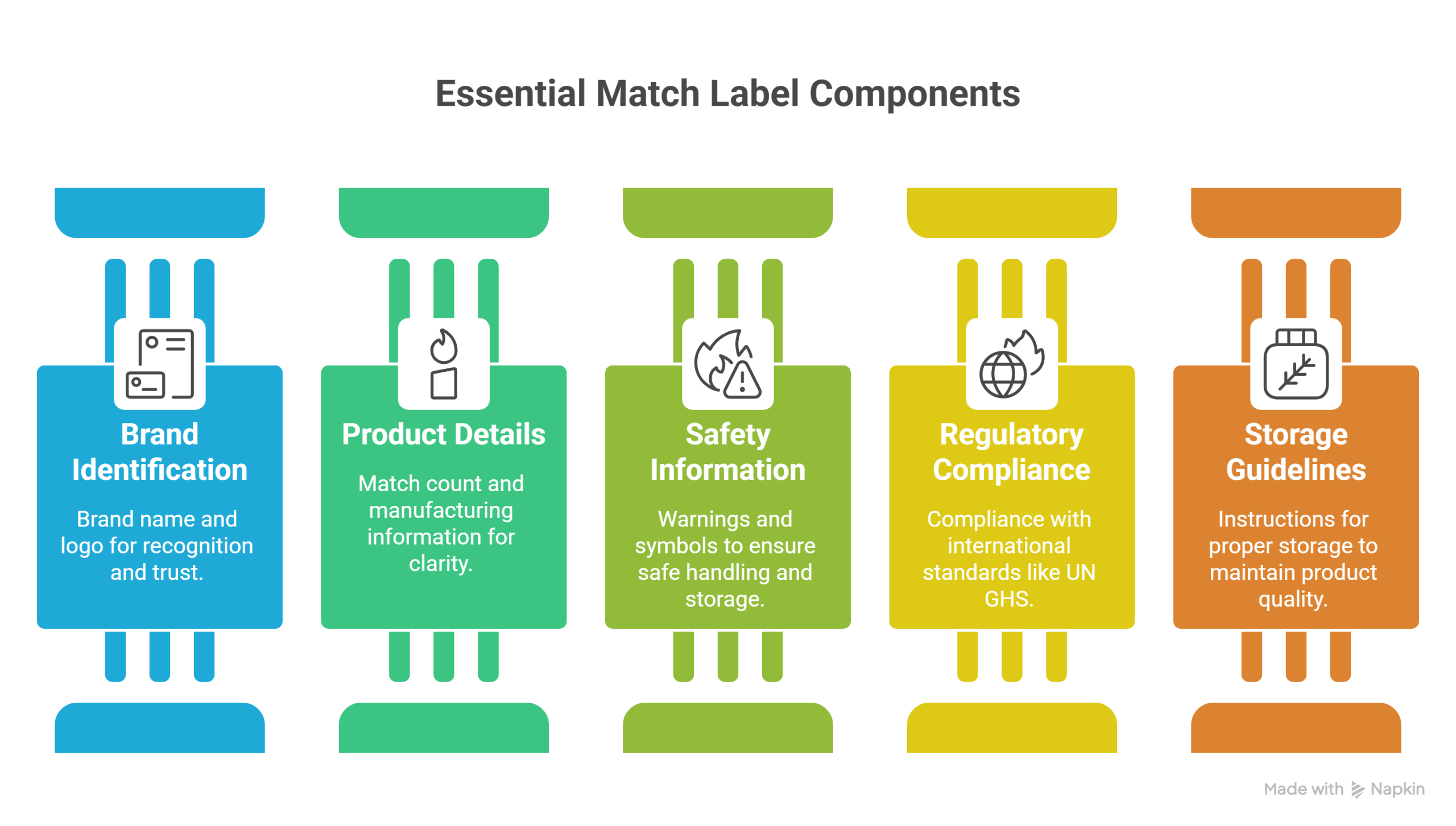
Standard Label Requirements
- Brand name and logo
- Match count per box
- Manufacturer name and country of origin (India)
- Safety warnings (language-appropriate)
- Flammable goods symbol (UN GHS flame pictogram)
- Batch/lot number and manufacturing date
- Storage instructions: keep dry, away from heat and children
 Private Label Minimum Order Quantities
| Format | MOQ (Cartons) | Lead Time |
| Standard Household Box (50 matches) | 500 cartons | 21 – 28 days |
| Long Matches / BBQ | 300 cartons | 25 – 35 days |
| Booklet Matches | 800 cartons | 18 – 25 days |
| Custom Size / Special Format | 1,000 cartons | 30 – 45 days |
Each carton typically contains 50 × 12 = 600 boxes (standard format), or as agreed per buyer specification. Pallet quantities and FCL (Full Container Load) pricing available on request.
Quality Control & Testing Protocols
Quenker Safety Matches infrastructure is highly advanced and quality-focused. Every batch produced by Quenker undergoes a rigorous multi-stage quality control process before dispatch. Our internal QC laboratory tests each production run based on the following parameters:
| Test | Standard / Method | Pass Threshold |
| Ignition Success Rate | ISO 4637 / internal protocol | ≥ 95% on first strike |
| After-Glow Test | EN 1783 | No after-glow > 5 seconds |
| Moisture Content (Splint) | ASTM D4442 | < 12% |
| Splint Tensile Strength | Internal pull-test | > 8N per splint |
| Striker Strip Durability | 60-strike minimum test | ≥ 60 successful ignitions |
| Box Compression Test | ISTA 1A | No deformation at 10 kg load |
| Humidity Resistance (Head) | 72hr @ 80% RH | Ignition success ≥ 90% |
| Shelf Life Verification | Accelerated aging test | 3-year minimum stability |
Shipping, Hazardous Goods Classification & Documentation
Safety matches are classified as dangerous goods under international transport regulations. Buyers must be aware of the correct classification to ensure smooth customs clearance and avoid shipment delays.
1. UN Classification
- UN Number: UN 1944 (Matches, safety)
- Hazard Class: 4.1 — Flammable Solids
- Packing Group: II or III depending on format
- Proper Shipping Name: MATCHES, SAFETY
2. Standard Shipping Documentation
- Commercial Invoice (English + destination language if required)
- Packing List
- Certificate of Origin (Chamber of Commerce certified)
- Material Safety Data Sheet (MSDS/SDS) — provided by Quenker for every product
- Dangerous Goods Declaration (DGD) — for sea and air freight
- Phytosanitary Certificate — for wood splint products (ISPM 15 compliance)
- Pre-shipment inspection certificate — where required by destination country
|
Important: Port & Regulatory Notes by Market
|
Storage & Handling Recommendations
Proper storage is critical for maintaining match quality from our factory to your end consumer. These guidelines apply to our buyers’ warehouses in all export markets.
- Store in a cool, dry environment — ideal temperature: 10°C to 30°C
- Relative humidity: below 65% — critical in tropical markets (Nigeria, Kenya, Zambia, Peru coastal)
- Keep away from direct sunlight, heat sources, and open flames
- Do not store near petroleum products, solvents, or acids
- Stack pallets no more than 3 high to avoid box compression and deformation
- First In, First Out (FIFO) stock rotation — shelf life is 3 years from manufacture
- In high-humidity markets, consider climate-controlled storage — especially for striker-strip integrity
Why International Buyers Choose Quenker Matches
With over a decade of export experience and a dedicated focus on emerging and developing markets, Quenker Exports has built a reputation for reliability, compliance, and customer-centric service. Here is what sets us apart:
| Capability | Details |
| Export Markets | Saudi Arabia, UAE, Yemen, Sudan, Nigeria, South Africa, Zambia, Kenya, Peru & more |
| Annual Capacity | Over 500 million matchboxes per year |
| Certifications | ISO 9001:2015 | CE | GCC / SASO ready | SONCAP listed |
| Private Label | Full design, printing & custom packaging in-house |
| Lead Times | 18 – 45 days (format & volume dependent) |
| Minimum Order | 300 cartons (standard formats); 1,000 for custom |
| Payment Terms | T/T, LC at sight, DA/DP negotiable for established buyers |
| Inspection | SGS / BV / Intertek pre-shipment available |
| Language Support | English, Arabic, French, Spanish documentation |
How to Place an Order with Quenker Matches
Quenker Matches is a leading safety matches exporter and manufacturer in India. Getting started with Quenker is straightforward. Follow these steps to go from enquiry to shipment:
- Send us your requirement: Box format, quantity, destination country, labelling requirements (private label or standard).
- Receive a quotation: We respond within 24–48 business hours with a proforma invoice including unit price, carton dimensions, weight, and shipping estimate.
- Sample approval: Pre-production samples available for new buyers and private label orders.
- Confirm order & advance payment: Production begins upon receipt of agreed advance or LC.
- Pre-shipment inspection & documentation: All certificates, DGD, and compliance documents issued before loading.
- Shipment & tracking: Full bill of lading, container tracking, and post-shipment support provided.
Ready to Source Safety Matches for Your Market? Contact Quenker Matches today for product samples, and export support for your target market.