
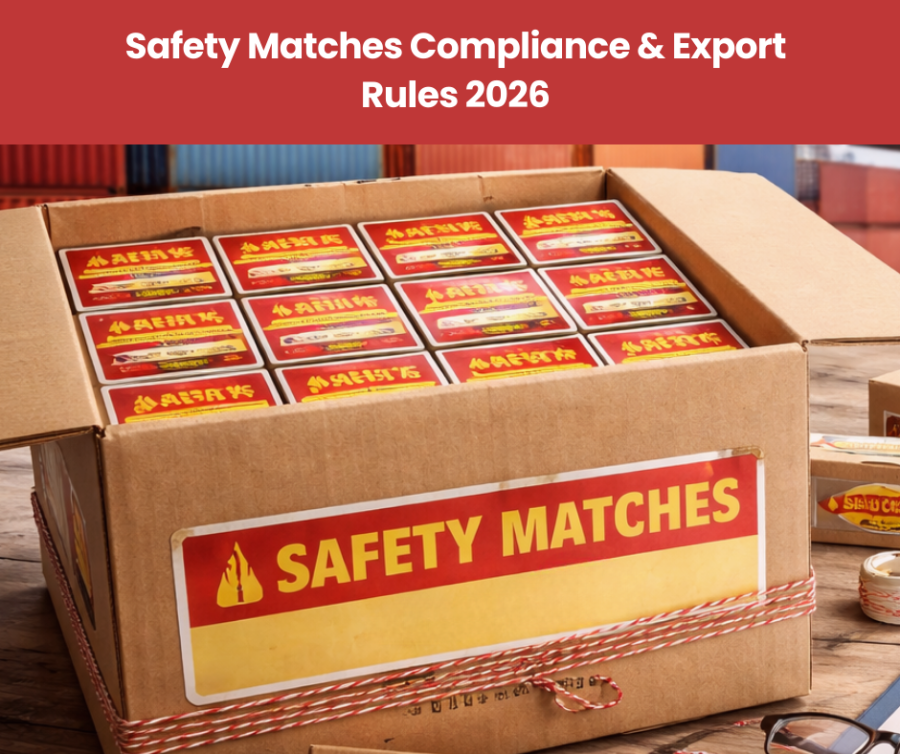
Global trade is changing rapidly. Stricter customs screening, sustainability mandates, hazardous goods classification updates, and country-specific packaging laws are redefining how products move across borders. For exporters in the match industry, 2026 will mark a decisive shift toward tighter enforcement and documentation scrutiny.
This blog explains the evolving safety matches export rules, essential matchstick export documents, and best practices to future-proof your export operations.
Why Export Compliance Is Needed
Several global trends are influencing updated safety matches regulations:
1. Hazardous Goods Monitoring
Matches fall under HS Code 3605 and are categorized as potentially hazardous goods due to their ignition properties. Authorities now demand precise chemical disclosure, proper UN classification, and transport compliance under IMO (for sea freight) and IATA (for air freight).
2. Sustainability and Traceability
Safety matches must increasingly comply with FSC-certified sourcing and sustainable timber regulations. Countries in Europe and parts of the Middle East require proof of responsible forestry practices.
3. Chemical Composition Restrictions
Stricter REACH regulations in Europe and similar policies in other markets require confirmation that match head chemicals comply with safety standards.
4. Packaging and Labeling Laws
Child-resistant packaging, multilingual labeling, and hazard symbols are now mandatory in many countries.
For exporters, this means Safety matches export processes must evolve from reactive paperwork handling to proactive regulatory planning.
Understanding Safety Matches Export Rules for 2026
The upcoming compliance framework does not introduce completely new regulations; instead, it focuses on tighter monitoring, stricter inspections, and stronger enforcement of already established export laws and standards.
Here are key areas exporters must monitor:
HS Code Classification (3605)
Misclassification leads to customs penalties. Ensure accurate product categorization for both wooden and wax safety matches.
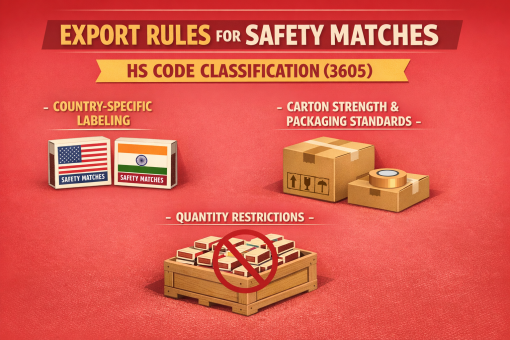
Country-Specific Labeling
Some regions require:
- Arabic labeling for GCC markets
- French labeling for parts of Africa
- Hazard symbols under international safety codes
Carton Strength & Packaging Standards
Export cartons must withstand humidity and sea transit pressure. Weak packaging can trigger cargo damage claims or customs holds.
Quantity Restrictions
Some countries impose specific limits on how many matchboxes can be packed within a single master carton for import compliance. To ensure smooth Safety matches export, exporters must stay informed about destination-specific safety matches export rules.
Matches Export Essentials
Compliance does not start with documentation alone; it begins inside the factory, where raw material selection, chemical formulation, quality control, and packaging standards determine export readiness.
1. Splint Quality
Uniform splints reduce breakage, ensuring safe combustion performance that aligns with international standards.
2. Controlled Chemical Coating
Precise phosphorus composition ensures strike reliability without violating global chemical thresholds.
3. Moisture Control
Improperly dried splints can fail inspection due to mold or instability during transit.
4. Strike Surface Quality
Strike-on-box matches must pass friction safety tests before export.
Compliance is not just about documents, it is about manufacturing discipline that aligns with global safety matches regulations.
Best Practices to Avoid Shipment Rejection in 2026
To minimize risk and maintain smooth Safety matches export, follow these best practices:
| Best Practice | Summary |
| Updated Documents | Keep export documents accurate and current. |
| Track Regulations | Follow latest export rule changes. |
| Sustainability | Secure FSC and ESG compliance. |
| Quality Checks | Inspect goods before dispatch. |
| Right Partners | Choose compliance-aware manufacturers. |
| Digital Records | Use digital tracking to avoid errors. |
Facts
- 13,196 shipments from India, making it the largest global exporter. [Volza]
- 528 exporters and 745 importers engaged in safety matches trade globally. [zauba]
By implementing these focused practices, exporters can significantly reduce compliance risks, prevent shipment delays, and ensure smooth customs clearance. Proactive preparation today is the key to uninterrupted and successful safety matches export in 2026 and beyond.
Matchstick Export Documents
Understanding and maintaining the correct matchstick export documents is critical to avoid shipment rejection.
1. Import Export Code (IEC)
Issued by DGFT (India), this is mandatory for all exporters. Without it, no shipment can legally leave the country.
2. Commercial Invoice & Packing List
These define product quantity, value, carton count, and packaging details, essential for customs assessment.
3. Certificate of Origin
Confirms the manufacturing country. Many African and GCC nations require this for tariff and regulatory purposes.
4. Phytosanitary Certificate
Since safety matches are wood-based products, some countries require verification that the wood is pest-free.
5. MSDS (Material Safety Data Sheet)
Specifies chemical composition and hazard classification. Increasingly important under updated safety matches regulations.
6. Dangerous Goods Declaration
Mandatory if required by shipping lines, confirming compliance with international hazardous goods transport standards.
7. Bill of Lading / Airway Bill
Proof of shipment issued by the carrier. Failure to maintain accurate matchstick export documents often results in port clearance issues or costly re-documentation.
Preparing Today for 2026 Compliance
The future of Safety matches export belongs to exporters who treat compliance as strategy, not as an afterthought. As global customs authorities strengthen enforcement, incomplete documentation or outdated certifications will no longer be tolerated.
Understanding safety matches regulations, organizing accurate matchstick export documents, and adapting to new safety matches export rules are critical steps toward long-term international success.
In 2026 and beyond, buyers will increasingly choose exporters who demonstrate transparency, sustainability, and documentation accuracy.
With its deep industry expertise, regulatory awareness, and commitment to quality, Quenker Matches stands ready to support compliant, seamless, and future-proof exports.
How Quenker Matches Supports Export Compliance
Quenker Matches is strategically equipped to produce and supply safety match products that meet global compliance and export standards.
As a leading manufacturer and supplier, Quenker Matches integrates:
- Accurate HS code classification and export documentation
- Compliance with international chemical standards
- Strong packaging aligned with export transit requirements
- Support in preparing complete matchstick export documents
- Ongoing monitoring of updated safety matches export rules
By combining strict manufacturing accuracy with proactive regulatory awareness, Quenker enables smooth, compliant, and low-risk safety matches export operations for international buyers.
Conclusion
Export compliance is not a barrier, it is a bridge to global trust. When documentation, packaging, and production align with international standards, Safety matches export transforms from a logistical challenge into a sustainable growth opportunity.
For exporters, traders, and sourcing agents seeking a reliable, regulation-ready partner, Quenker Matches delivers confidence with every shipment.
Stay ahead of global export rules. Partner with Quenker Matches for reliable and regulation-ready safety matches export solutions.
FAQ’s
1. What are the key documents required for safety matches export?
Essential documents include IEC, commercial invoice, packing list, Certificate of Origin, MSDS, and shipping documents like the Bill of Lading.
2. Why are safety matches export rules becoming stricter in 2026?
Governments are tightening enforcement to improve hazardous goods control, sustainability compliance, and accurate customs documentation.
3. What is the HS Code for safety matches export?
The standard HS Code for safety matches is 3605, used for customs classification worldwide.
4. How can exporters avoid shipment rejection?
Maintain updated matchstick export documents, follow destination-country regulations, ensure proper labeling, and conduct pre-dispatch inspections.
5. Why is sustainability important in safety matches export?
Many countries require proof of responsible wood sourcing and chemical compliance, making certifications like FSC increasingly important for global trade.
